‘O Jesus, send me a wound to-day,
And I’ll believe in Your bread and wine,
And get my bloody old sins washed white!’
These are the closing lines of Siegfried Sassoon’s war poem Stand-To: Good Friday Morning (1916). The soldier despises life at the front, and makes a deal to accept Christianity so long as Jesus arranges an injury that will get him invalided out of the trenches. It’s cynical and transactional, but unlikely to offend modern readers.
This was not the case in New Zealand in 1922, when John Glover was prosecuted under the law of ‘blasphemous libel’ for publishing Sassoon’s poem in his socialist newspaper The Maoriland Worker. The combination of religion and profanity was apparently too much. To those who wished to impose a narrow reading of the poem, it seemed to be parodying the very notion of Christian repentance and redemption. Glover faced one year in prison but was eventually acquitted. He has the distinction of being the only person ever prosecuted under this law from its inception in 1893 to its repeal in 2019.
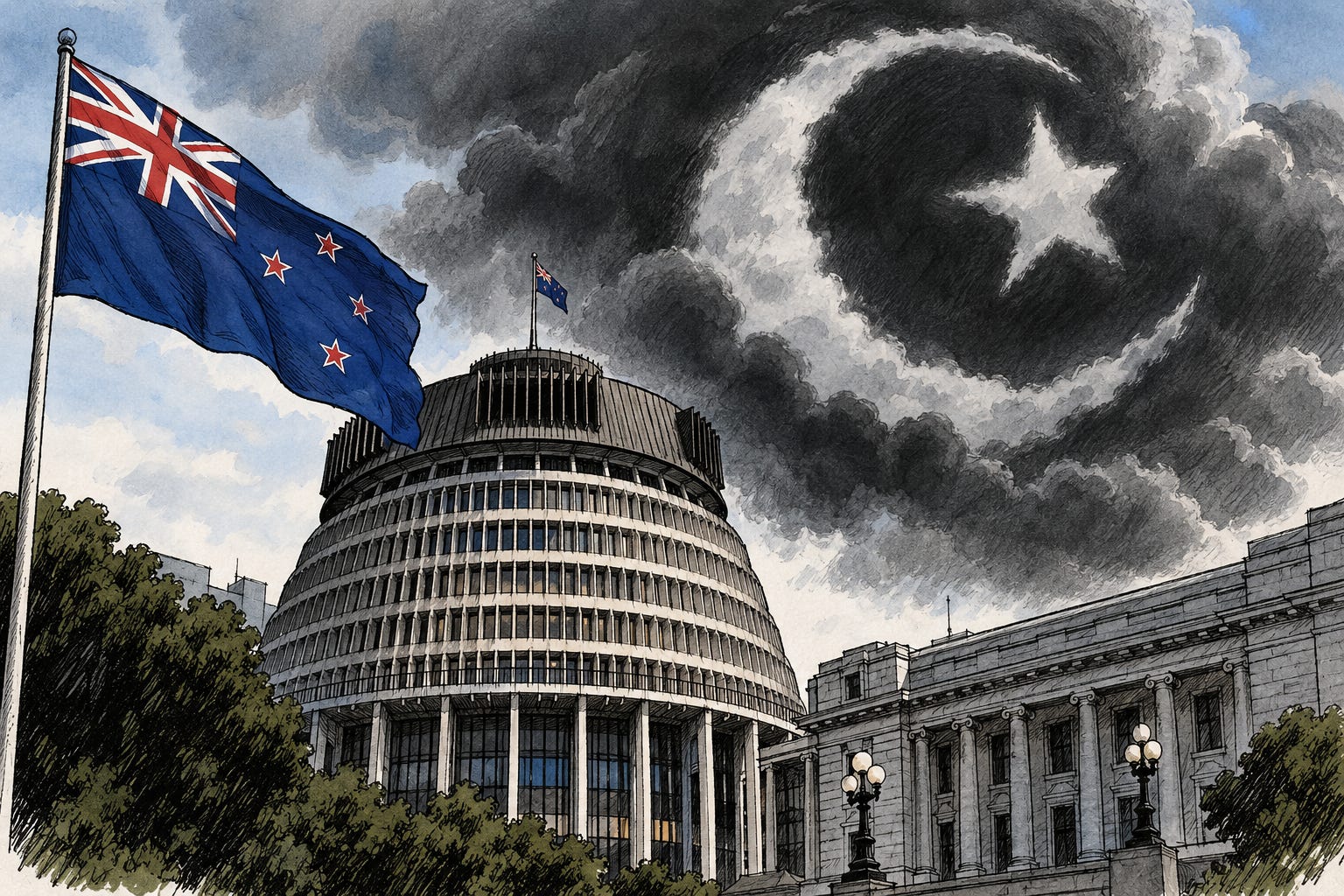
The New Zealand chapter of the Free Speech Union is currently warning that there are moves afoot to reintroduce blasphemy law by the back door. We have seen it happen in the UK. Former police officer Stephen Gray was recently found guilty of an offence under Section 127 of the Communications Act 2003 for reposting a joke about Islam on Facebook. The image was of a man in a turban and a rasher of bacon along with the caption: ‘Fun facts about bacon! People who eat bacon have a lower chance of marrying a nine-year-old!’
Gray testified in court that he was one of thousands who had shared the post, and that it was a joke concerning the marriage of the Prophet Mohammed and Aisha. According to Sahih al-Bukhari, one of the most authoritative collections of hadith in Sunni Islam, Aisha was six when the marriage took place and nine when it was consummated. Remarkably, the judge ruled that Gray’s reposting of a meme on this subject was not within the bounds of acceptable free expression. So while Islamic blasphemy codes are not officially on the statute books in the UK, they may as well be.
The Free Speech Union of New Zealand is concerned that its own country is following the sinister path that the UK has taken. It has created a petition against the ‘seven-year lobbying campaign’ that ‘wants religion written back into our speech laws before the election’. As the petition warns: ‘it is closer to winning than most New Zealanders realise’.
Much of this can be dated to the atrocity at two mosques in Christchurch in March 2019, in which a far-right terrorist murdered fifty-one people and injured another forty. It is understandable that in the collective shock and anger that followed, many people strove to find somebody to blame. Australian senator Fraser Anning blamed Muslim immigration. Trans activist Brianna Wu implicated Tucker Carlson. A student at a vigil in New York City harangued Chelsea Clinton, saying the attack had been ‘stoked by people like you’. A chain of bookstores in New Zealand stopped selling Jordan Peterson’s 12 Rules for Life, thereby outrageously implying a connection between the massacre and this explicitly anti-authoritarian book.
The Royal Commission established after the Christchurch atrocity examined New Zealand’s laws concerning ‘hate speech’. It considered whether the existing law covering incitement against protected groups – section 131 of the Human Rights Act 1993 – should incorporate religious belief. It concluded not only that religion ought to be afforded the same protections as ethnicity, but that section 131 should be replaced with a more tightly drawn criminal offence in the Crimes Act. The new offence would cover racial and religious groups but would require an intention to ‘stir up, maintain or normalise hatred’.
What exactly does this mean? Once again, we find ourselves facing the fundamental problem of all hate speech laws. Specifically, no government has yet satisfactorily defined ‘hate’ or explained how such a subjective term can be protected from weaponisation by those who wish to silence their critics. Both the European Court of Human Rights and UNESCO have conceded that ‘hate speech’ is not a concept that can be meaningfully defined, and yet countries throughout the Western world have accepted the principle that they should be legislating against their citizens’ emotions.
The Royal Commission was at least conscious of the danger. It acknowledged that extending hate speech laws to religion raised ‘distinct freedom of expression issues’, and noted New Zealand’s strong tradition of permitting robust criticism of religious belief. But it nevertheless rejected the kind of explicit safeguard found in British law – woefully inadequate though it has proved in practice – which protects ‘discussion, criticism or expressions of antipathy, dislike, ridicule, insult or abuse’ of religions and religious practices. The Commission’s concern was that such a provision had made prosecutions for stirring up religious hatred too difficult in the UK.
This is as revealing as it is disturbing. The very protections designed to ensure that criticism and ridicule of religion remain lawful were treated not as an essential safeguard for free expression, but as an obstacle to successful prosecution. Of course, it should go without saying that religious faith is not an immutable characteristic. For all the efforts of activists to rebrand scepticism about Islam as a form of ‘racism’, the idea has never taken hold because, quite simply, Islam is no more a race than Christianity or Marxism. Any society that does not permit criticism and ridicule of beliefs cannot be said to be free.
The New Zealand government did not adopt the Royal Commission’s proposed new Crimes Act offence. Instead, it introduced the Human Rights (Incitement on Ground of Religious Belief) Amendment Bill in December 2022, which would have extended the existing Human Rights Act provisions to cover religion. In particular, section 131 already made it a criminal offence to use abusive or insulting language, with the requisite intent, that was likely to ‘excite hostility or ill-will against, or bring into contempt or ridicule’ a protected group. The bill would have added religious belief to those protections. The bill passed its first reading, but the government subsequently decided not to proceed.
It should have ended there. But this June, Destiny Church leader Brian Tamaki accused Indian Prime Minister Narendra Modi of ‘purging India of all Christians and burning church buildings down’. Tamaki said: ‘I think we should reciprocate in kind. Let’s purge New Zealand of Hindus, Sikhs and Muslims. And, while we’re at it, if they’re burning churches down, why don’t we burn mosques and their temples down? Tit for tat.’ These remarks are obviously indefensible but, as ever, the most reactionary and extreme sentiments are often fodder for those who wish to introduce censorship on a much broader scale.
Inevitably, Tamaki’s remarks have prompted renewed calls for tougher hate speech legislation. Amnesty International Aotearoa New Zealand has written to the government arguing that the existing incitement provisions ‘need work’, calling for the implementation of the Royal Commission’s recommendations so that religion can be deemed a protected group. This comes off the back of years of campaigning by the Federation of Islamic Associations of New Zealand, which has pressurised political parties to return to the recommendations of the Royal Commission.
The Free Speech Union has unequivocally condemned Tamaki’s comments. Its CEO Jillaine Heather has described them as ‘divisive and inflammatory’ and said that they ‘run contrary to the principles of a free and pluralistic society’. She continues:
‘The true test of a commitment to free speech is not whether we defend speech we agree with, but whether we defend the right of people to express views we find offensive, disturbing, or even abhorrent. The primary response to bad speech should be criticism, rebuttal, and public condemnation, not an appeal to state power.’
This is the key point. Genuine threats and incitement to violence are already covered by existing criminal law in New Zealand. Condemnation and counter-criticism are always far more effective than censorship, because bad ideas are not destroyed when silenced; they are driven underground where they can fester unchallenged.
For those New Zealanders who still care about liberty, now is a challenging time. No doubt calls for censorship and tighter hate speech laws will become more intense. In such circumstances, the prosecution of John Glover in 1922 is worth remembering. Back then, the state sought to punish the publication of a poem because its treatment of Christianity was considered sufficiently offensive to warrant criminal sanction. Today, the same impulse is re-emerging, with the causing of offence recast as ‘hatred’. If New Zealand is to remain a free country, its leaders must accept that nobody is entitled to protection from ridicule or contempt.
I will be touring New Zealand from 12th to 16th September in a series of talks for the Free Speech Union. Details and tickets to these events at Auckland, Wellington and Christchurch are available here.


I would say "Keep flying the flag", if that expression, instead of simply being approving and encouraging, did not mean that either of us would be jumped on by a local Council or a bunch of suicidal-empathy supporters (who have never heard of Gad Saad or understood the phrase "suicidal empathy".)
The way Islam keeps a stranglehold over its people is through religion, the Q'oran. If we hold it in contempt and derision, how long before some muslims will start querying its value? Then the Iman loses his power and even possibly his voter base. Thus the panic over blasphemy.