Britain’s far-right panic
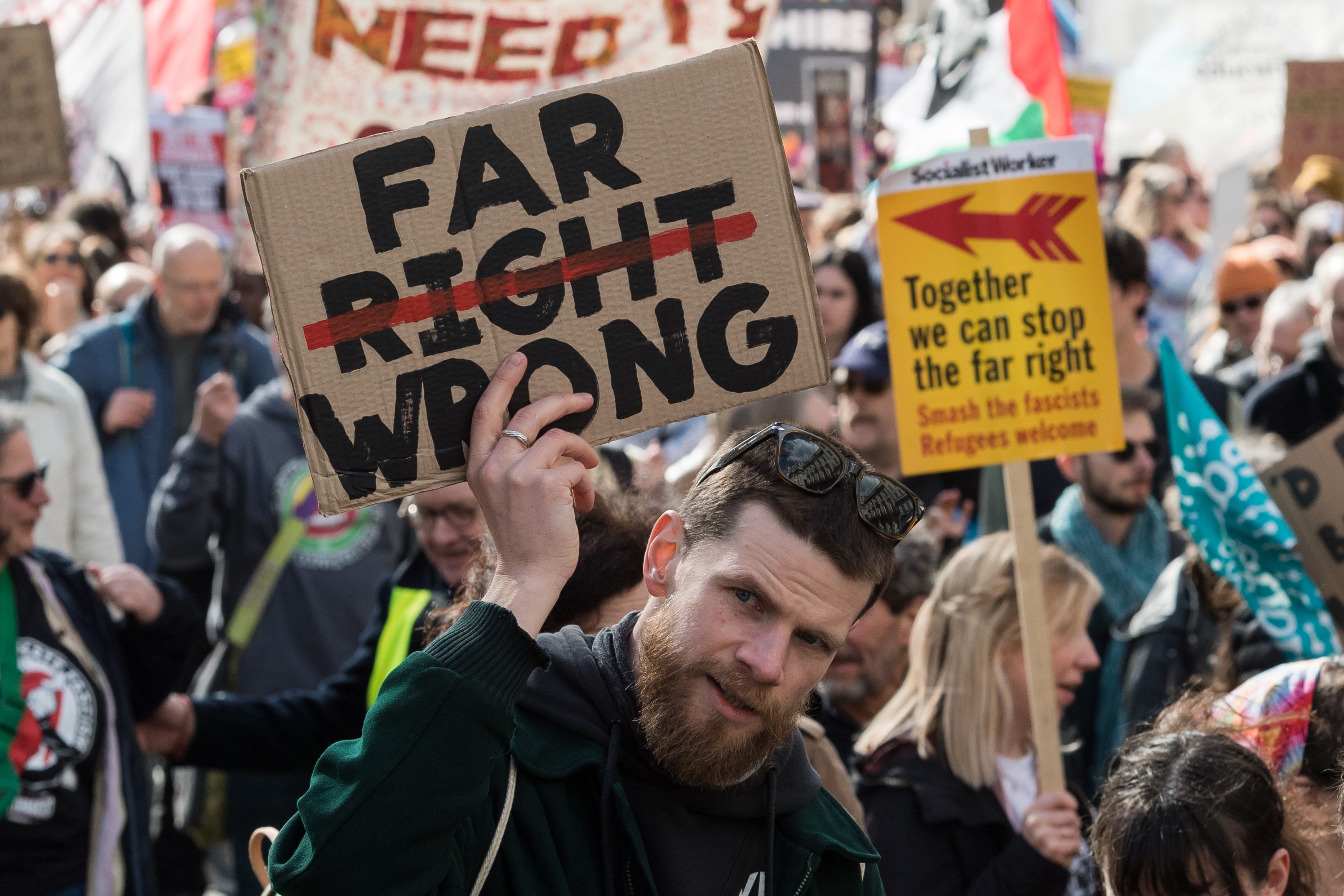
Campaigners took to the streets of London this weekend to protest against the monsters of their imagination.
In 1692, a coalition of villagers, ministers, judges and other local authorities took on the witches of Salem, Massachusetts. The trials lasted just over a year, but by the end more than two hundred had been accused, twenty had been executed and five others had perished in jail. There was just one problem: the witches did not exist.
It is tempting to make the comparison between what happened at Salem and today’s culture war, with activists similarly determined to vanquish imaginary foes. Just this weekend, there was a march in London by the Together Alliance to oppose the ‘far-right’, a movement that has become increasingly fringe in recent years and has virtually no public support.
The march was an example of virtue signalling on a colossal scale. The organisers claim that there were over half a million in attendance. The Met Police have estimated that the true figure is just ten per cent of that, closer to 50,000. As ever with culture warriors, the concept of truth is entirely subjective.
A number of celebrity spokespeople were present, including Lenny Henry, Paloma Faith and one of the members of Little Mix, which might explain why the numbers were lower than expected. That said, over a hundred charities, trade unions and campaign groups were represented. In his address to the crowd, Green Party leader Zack Polanski declared: ‘We will defeat hate. It’s time to make hope normal again’. He may not be much of a political thinker, but when it comes to vacuous sloganeering he is peerless.
But the question remains: what precisely were they marching against? The organisers claim that it was a response to Tommy Robinson’s ‘Unite the Kingdom’ rally in September. The attendees at that march had been smeared in the media as ‘far-right’, despite the fact that the overwhelming majority were nothing of the kind. As Trevor Phillips reported at the time, it was ‘no gathering of white supremacists’, but rather an event for ‘ordinary people’. As he put it, ‘if LS Lowry were to paint the scene’ he might have called it ‘Middle Britain on a day out in London’.
So is this the ‘far-right’ that the Together Alliance is so worried about? This weekend’s march was really the product of a collective fantasy: the persistent belief that fascism is on the rise and even normalised in the UK. By reclassifying common concerns over illegal immigration as ‘far-right’, the likes of Together Alliance are able to assert that there has never been more hatred or division. One may as well reclassify squirrels as woolly mammoths and celebrate the de-extinction of the species.
This is not to suggest that the far-right does not exist, or that it does not pose a threat. There will always be a handful of extremists of all political persuasions who are willing to cause havoc, but such outliers are unlikely to be swayed by a protest or a rendition of ‘Bella Ciao’ by Little Mix. The Together Alliance protest, in other words, achieves nothing. Its stated aims – opposition to the far-right, racism, hatred and division – are simply reiterations of what almost everyone already believes. It’s an argument that has long been won. It would be just as productive for the Together Alliance to hold a protest against those who believe that the earth is flat.
Far from enjoying a political resurgence, the far-right remains a laughing stock. The last time a far-right party won a local election was in 2006 when the BNP took Barking and Dagenham. Far-right organisations are generally small and fragmented and attract only limited membership, often numbering in the hundreds or low thousands at most. To put this into context, membership of the UK’s Cloud Appreciation Society is approximately 60,000 strong.
The far-right, in other words, is an extremely fringe movement, not the mainstream threat that the likes of Together Alliance would have us believe. It is curious that those who proclaim to be most opposed to fascism are determined to promote it by inflating its influence. It is similarly baffling that the most overt expressions of racism that we have seen in recent years have been on supposedly ‘anti-racist’ marches, where antisemitic slogans and placards are not uncommon.
The Together Alliance march is simply the latest demonstration of the hysterical mindset of self-proclaimed ‘progressive’ activists. They have crafted an identity based on the false premise that fascism has become a major force, and are immune to data or facts that contradict this narrative. The only way they have been able to artificially inflate the numbers is to conflate populist movements and legitimate concerns about illegal migration with ethno-nationalist and racist ideologies. It’s a low trick.
The Together Alliance has been so named in order to disguise its inherently divisive nature. Thankfully, while their members peddle their bleak and regressive vision of a UK in the chokehold of fascism, the majority of the public are still wedded to reality. Yet as the example of Salem teaches us, there is always a danger when these toxic fantasies go unchecked. The witches may be imaginary, but the consequences of the hunt are often all too real.


What we are living through is the end result of the long march through the institutions. It has produced generations of useful idiots. If there is a threat from the ‘far right’ they are it. They are the ones shutting down free speech and behaving like tin pot dictators. It’s time they were thoroughly mocked. How about an AI image of Lenny Henry and minions dressed as Spode in Jeeves and Wooster all marching with their knobbly knees on full display.
I have been continuously drawn back to the Crucible. There seems to be a spiralling hysteria with accusations of fascism drawing in more and more groups. Who will be going to the gallows?