

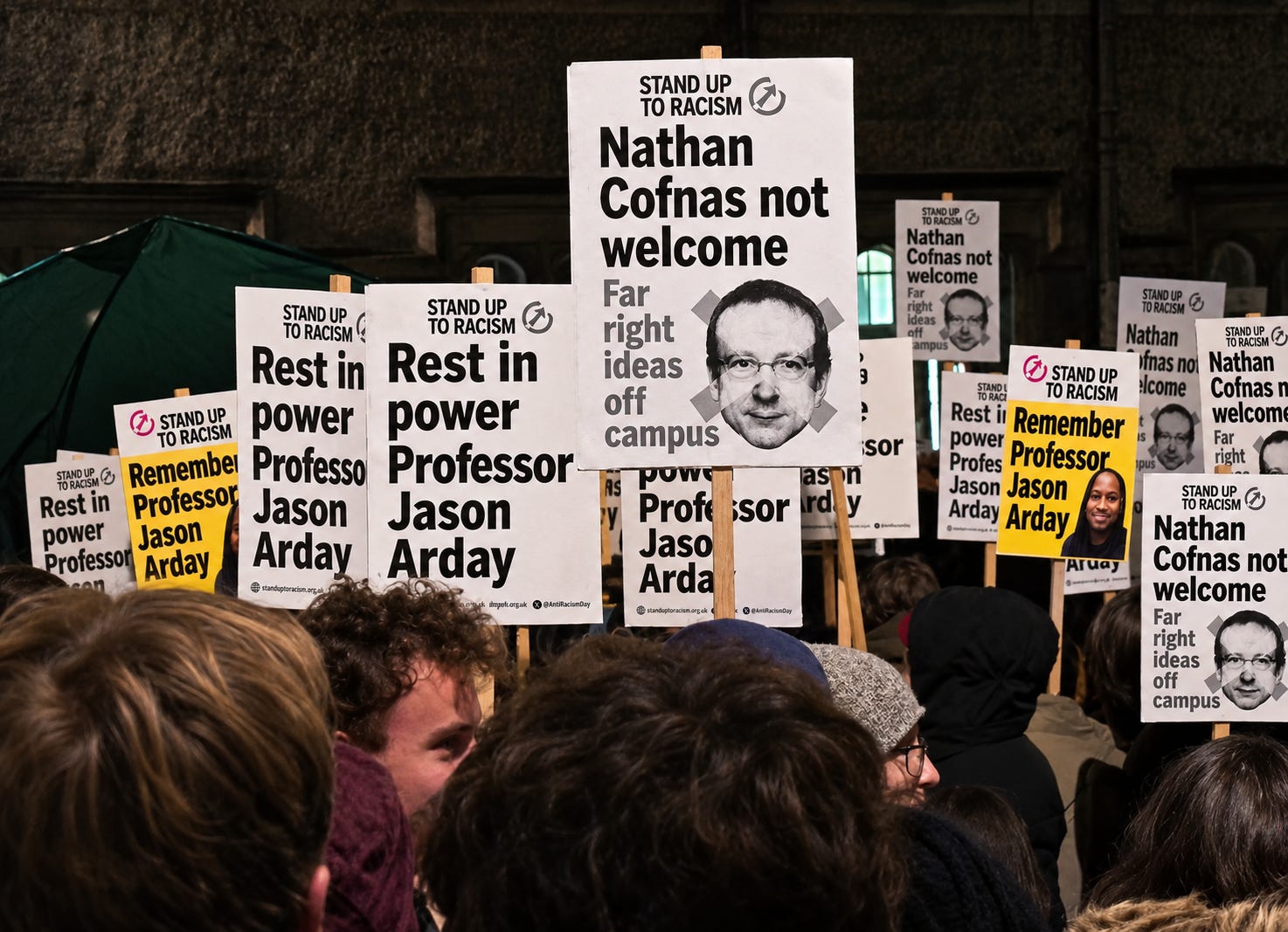
In 1968, the governing body of Wadham College, Oxford, was presented with a set of ‘non-negotiable demands’ by students. Its response was perfect:
Dear Gentlemen: We note your threat to take what you call ‘direct action’ unless your demands are immediately met. We feel it is only sporting to remind you that our governing body includes three experts in chemical warfare, two ex-commandos skilled with dynamite and torturing prisoners, four qualified marksmen in both small arms and rifles, two ex-artillerymen, one holder of the Victoria Cross, four karate experts and a chaplain. The governing body has authorized me to tell you that we look forward with confidence to what you call a ‘confrontation,’ and I may say, with anticipation.
If only universities were so robust today. Students have grown accustomed to getting their own way, being treated like customers, and being coddled when they demand ‘protection’ from challenging views. Many of them have enjoyed the heckler’s veto. They have been led to believe that if they object loudly enough to an event, it will simply not be allowed to go ahead.
All of this seemed to be encapsulated at Oxford yesterday evening, when hundreds of protesters descended on Oriel College in an attempt to prevent the American academic Nathan Cofnas from speaking. Entrances to the college were blockaded. Protesters climbed walls and tried to force their way onto the grounds. There were clashes with police and reports that security staff had been injured. Attendees were obstructed and, according to several eyewitnesses, some were physically attacked.
But why? Nathan Cofnas describes himself as a ‘race realist’ and has repeatedly argued that genetic differences contribute to disparities in average intelligence between racial groups. In 2024, he published an essay entitled ‘A Guide for the Hereditarian Revolution’, in which he considered what would happen if universities and other institutions abandoned racial preferences and operated according to a strict meritocracy. Black people, he concluded, would ‘disappear from almost all high-profile positions outside sports and entertainment’. This is the line his detractors cite most often.
But whatever one makes of Cofnas’s opinions, the principle of free speech is what matters here. He had been invited to Oxford by the Reform Society to give a talk on the perfectly reasonable question: ‘Is DEI Undermining Higher Education?’ The sensible response to an argument with which you disagree is surely to hear it and challenge it. Many of the protesters opted for violence instead.
Before the event, the Oxford Students’ Coalition Against Racism had organised a petition demanding its cancellation which attracted more than 32,000 signatures. Stand Up to Racism issued its own statement describing Cofnas’s ideas as ‘scientific racism and eugenics’, arguing that Oriel had responsibilities towards the welfare of its black students and staff, and calling on the college to intervene.
Oriel College, to its credit, refused to cancel. It made clear that the invitation had come from a registered student society and that allowing it to proceed did not amount to an endorsement of Cofnas’s views. It also pointed to its statutory obligation to uphold lawful freedom of speech. Its own code of practice is explicit that debate should not be prevented merely because people find the ideas offensive.
The demonstration on Tuesday night included groups such as Stand Up to Racism, Oxford Resists and Black Lives Matter UK, as well as a smaller group of students from Oriel itself who protested inside the college grounds. Many were peaceful, but a significant contingent were there to impose their will. Samira Ali, national organiser of Stand Up to Racism, told the crowd that the Reform Society represented ‘a danger to black students and diversity on campus’. She made her objective explicit, saying: ‘We are here to shut down that meeting. Reform Society, we are coming for you, and we will shut you down too’.
This is authoritarianism. It goes without saying that peaceful protesters should have the freedom to make their case, however loudly and offensively they choose. But this does not give them the right to assault people or prevent them from exercising their own rights…
— To continue reading this article, please consider becoming a paid subscriber —
