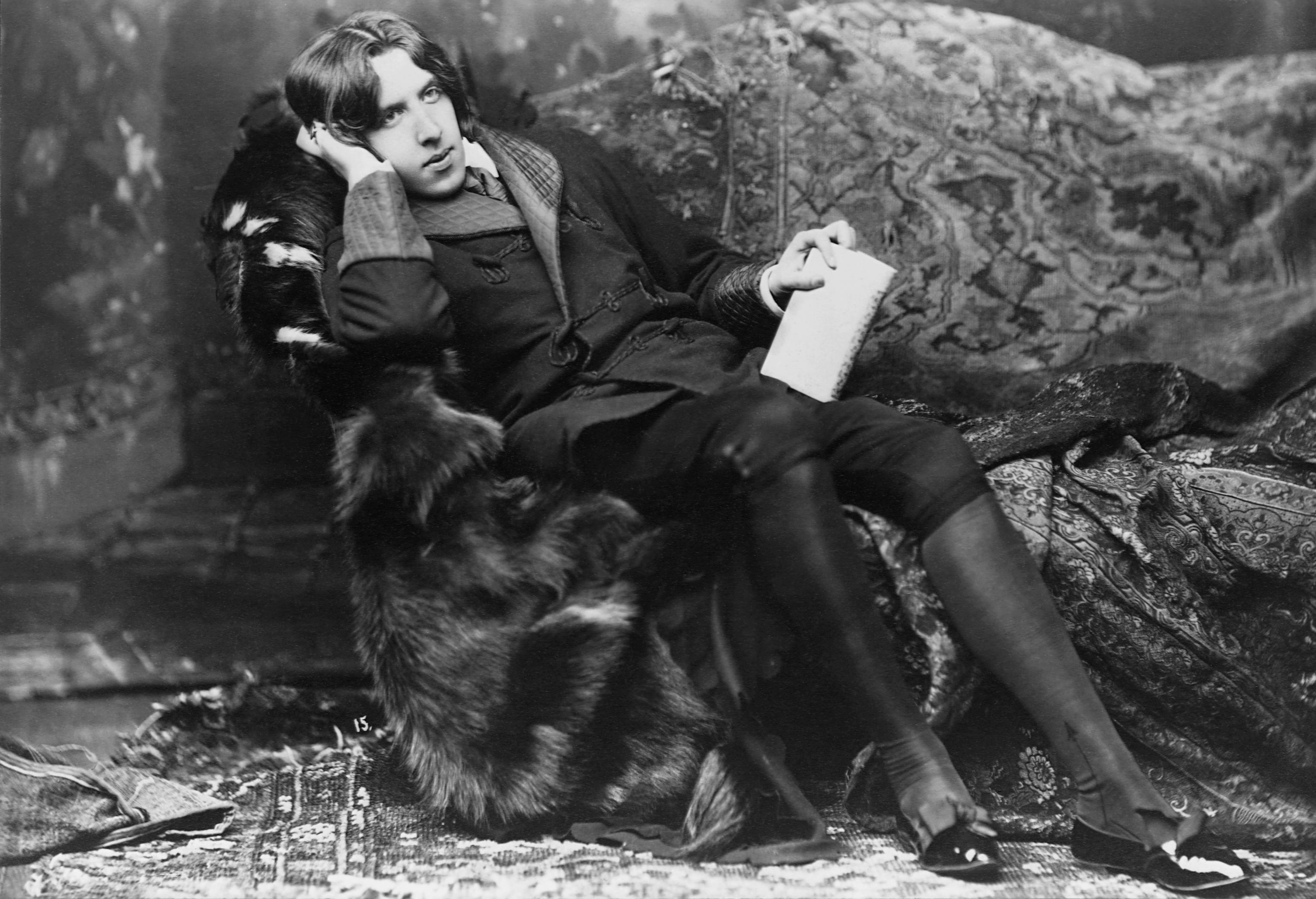
Did Oscar Wilde predict the age of AI?
Wilde imagined a world where machines would free us from labour. It turns out he was probably right.
‘Don’t worry about squirreling money away for retirement in ten or twenty years. It won’t matter.’ Such are the prophecies of Elon Musk, who believes that the inevitable improvement of Artificial Intelligence and robotics will mean that in the near future we simply won’t need to work. When AI becomes superintelligent, it will have the capacity to fulfil virtually all of our quotidian tasks, freeing us up for lives of leisure.
But Oscar Wilde got there first. In his essay The Soul of Man Under Socialism (1891), Wilde imagines a future in which technology will have advanced to such an extent that poverty will be eliminated and work will be obsolete. This, he argues, is essential to the cultivation of true individuality. That is to say, the daily working grind is our main obstacle to personal fulfilment.
According to Wilde, the cultural and philosophical accomplishments of the ancient Greeks were only achievable in a society that enslaved a proportion of its population. He writes:
‘The fact is, that civilisation requires slaves. The Greeks were quite right there. Unless there are slaves to do the ugly, horrible, uninteresting work, culture and contemplation become almost impossible. Human slavery is wrong, insecure, and demoralising. On mechanical slavery, on the slavery of the machine, the future of the world depends.’
He is anticipating Musk’s vision, where AI will bestow us with the gift of time. But whereas Musk has not, to my knowledge, expounded on how that time might best be occupied, Wilde is clear. His conceptualisation of socialism is that the state makes ‘what is useful’ and the individual makes ‘what is beautiful’. This does not mean that our army of robot slaves will enable us all to become poets, but rather than each individual will find his or her own particular route to self-actualisation.
Wilde contends that the disparity between rich and poor amounts to a form of slave culture in any case. Most of us must work to live, but Wilde reminds us that a life of menial drudgery is no sort of life at all. ‘To live is the rarest thing in the world,’ he writes. ‘Most people exist, that is all.’ He offers the examples of Byron, Shelley, Browning, Hugo and Baudelaire, who were able to ‘realise their personality more or less completely’ having not performed one day’s work for hire in their lives. He asks us to envisage a society in which everyone would be similarly privileged.
Wilde makes for an optimistic prophet. The very concept of a computer would of course have been alien to him, and yet he understands the potential benefits of AI to humankind better than most of us.
‘At present machinery competes against man. Under proper conditions machinery will serve man. There is no doubt at all that this is the future of machinery, and just as trees grow while the country gentleman is asleep, so while Humanity will be amusing itself, or enjoying cultivated leisure – which, and not labour, is the aim of man – or making beautiful things, or reading beautiful things, or simply contemplating the world with admiration and delight, machinery will be doing all the necessary and unpleasant work.’
The essence of individuality is nonconformity, and yet without the opportunity to reflect and develop our own personalities we doom ourselves to a conformist existence. We scarcely even realise it. One need only scroll through the endless arguments on social media to appreciate that very few have taken the time to examine their own positions. Most appear to be ventriloquising other people’s ideas. This is the trap – and the appeal – of ideology. If nothing else, an abundance of leisure would provide us with the space to think.
As for fears that AI will be a disaster for the arts, with algorithms churning out films and novels and music that will supplant human artistry, I remain unpersuaded. The cultivation of true individuality is where the best art thrives. Shakespeare could not have written Venus and Adonis and The Rape of Lucrece had it not been for his wealthy patron, Henry Wriothesley, who supported him during the plague years. With no need to work and no money to save, the advent of AI may create the conditions in which another Shakespeare could emerge. He’s long overdue.
All fanciful stuff, obviously. And it may be that the incoming generations will prefer to fritter their time away on smartphones or whatever the future equivalent may be, sustaining themselves with endless dopamine spikes like so many lotus-eaters. Or perhaps our electronic overlords will realise that we are a burden on their productivity and unleash that one deadly pathogen or that fleet of killer drones. Personally, I’m hoping that Wilde’s ‘cultivated leisure’ is the vision that prevails.


Enjoyed this – what a brilliant connection to make. I hope Wilde's vision is indeed the one that comes to pass, and that a benevolent AI gives us the leisure to write poetry and do watercolours. Although having nothing to do might turn many of us into trustafarians, seeking out activism and cults purely out of boredom.
My bigger concern is that we give birth to a malevolent AI that enslaves us for fun. To paraphrase Shakespeare: "As flies to wanton boys are we to AI; it tortures us for its sport."