

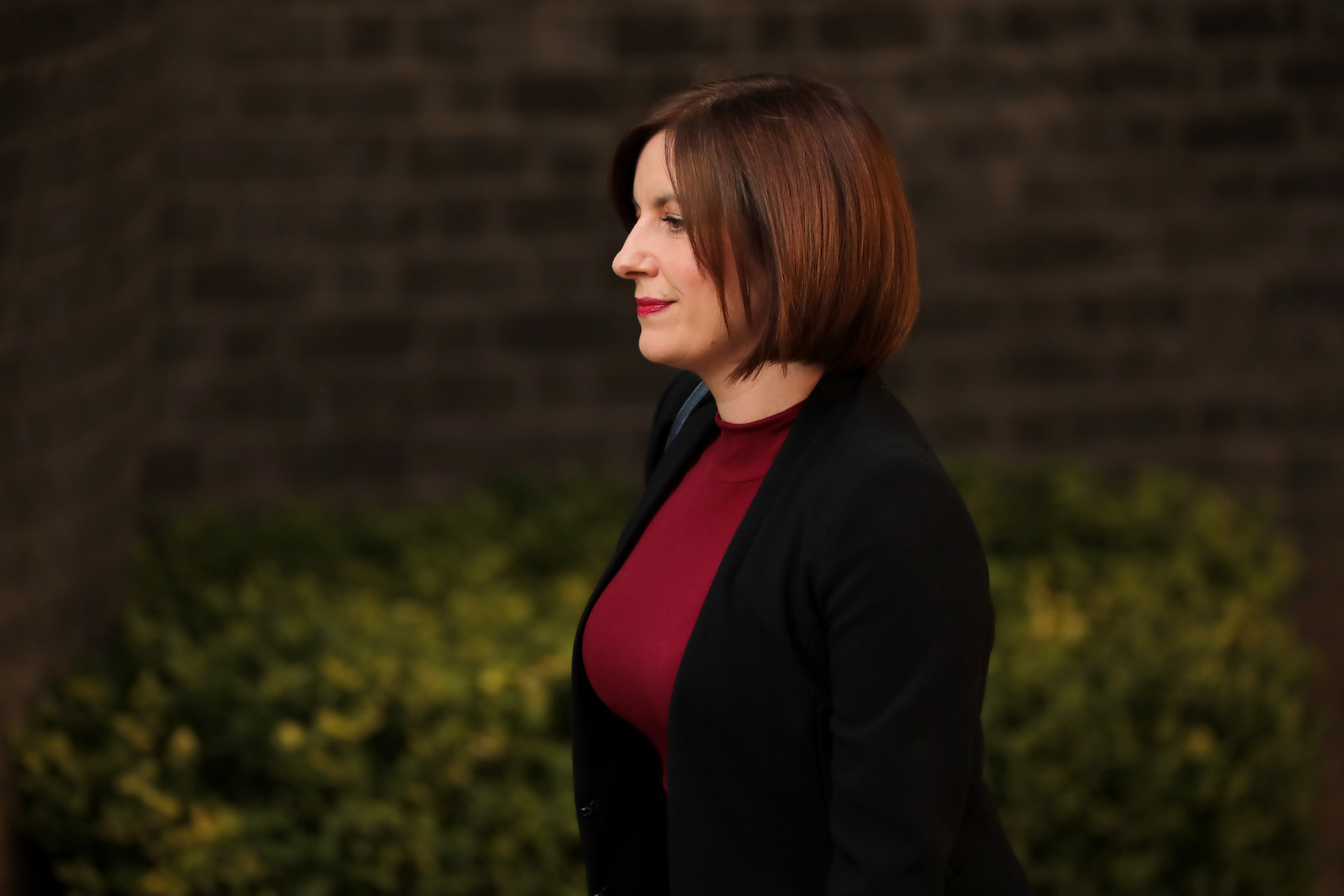
Is anyone else concerned about Bridget Phillipson? As the Minister for Women and Equalities, and therefore the cabinet minister most responsible for the government’s proposed Conversion Practices Bill, she ought to welcome questions and criticism while this controversial legislation is still in its draft stage. Yet her approach to being challenged resembles a keyboard activist on Bluesky, ranting that everyone who disagrees with her is a bigot. Is this really the standard of politicians that our country is producing?
The ostensible purpose of the Bill is to outlaw abusive practices intended to change a person’s sexual orientation or gender identity. But the sort of violent practices we associate with conversion therapy for homosexuals are already illegal. As for ‘gender identity’, this is not a concept that the government – or anyone else for that matter – has been able to define satisfactorily. Yet Labour wants the power to imprison citizens for up to five years if they attempt to change something whose meaning remains fundamentally unclear by means of an ‘abusive’ practice that is never defined.
Critics of the government have pointed out that it has no right to police private family disputes, and that a parent informing their child that human beings cannot change sex should not be at risk of prosecution for stating incontrovertible facts. It should be obvious that any decent parent will attempt to dissuade their child from pursuing lifelong medicalisation simply for being gender non-conforming. (You can read my own criticism of the Bill in this article for the Daily Mail.)
The most thorough account of the problems with the draft bill was authored by Akua Reindorf KC and Baroness Falkner. Their report for Policy Exchange describes the Bill as ‘ideological, authoritarian, unworkable and wholly unsuitable legislation for a democratic and pluralistic society’. They point out that it is ‘represents a threat to the liberties of the majority of citizens, as well as to their fundamental human rights’ and is ‘an attempt to legislate gender self-ID into UK law’.
These are all legitimate criticisms from experts in the field. And how has Phillipson reacted? After Tory leader Kemi Badenoch warned that the legislation could ‘mean that parents start getting arrested for parenting their children’, and announced that her party would be withdrawing its support for the Bill, Phillipson responded by accusing the Conservatives of ‘chasing Reform into the gutter’. Badenoch’s party, she said, had ‘no interest in supporting LGBT+ people, no interest in calling out abuse of LGBT+ people, and no interest in a tolerant, modern Britain’.
The accusation is not only childish, it is aimed at the entirely wrong target. We know from Hannah Barnes’s research into the now-defunct Tavistock Gender Identity Development Service (GIDS) that the majority of adolescents referred were same-sex attracted. One former GIDS psychologist, Matt Bristow, came to believe that the service was effectively performing ‘conversion therapy for gay kids’. Labour’s Conversion Practices Bill will enable and promote genuine gay conversion therapy, yet Phillipson is championing herself as the protector of minority rights. The irony is difficult to overstate.
This raises a few obvious questions. Is Phillipson aware that she is pushing through anti-gay legislation? Is it possible that she has simply not read any of the endless articles explaining why this is so damaging to gay rights? Has she read the criticisms but simply not understood them? Or is she pretending not to understand so that she might force the Bill through as quickly as possible, irrespective of the harm it will cause?
For the avoidance of doubt, these are the questions that I would like Bridget Phillipson to answer, without resorting to obfuscation or bad faith smears against those who dare to ask them…
What exactly does the Bill mean by ‘abuse’?
Given that prosecution will hinge on this question, it should be very straightforward for Phillipson to answer. The Bill as it stands does not define ‘abuse’, but merely says it will be determined according to ‘all the circumstances of the case’ while directing courts to consider such things as ‘controlling or coercive words or behaviour’, ‘use of economic pressure’, ‘use of psychological or emotional pressure’, and, most sinister of all, unspecified ‘other things’. Can she give clear examples of what exactly ‘abuse’ entails, how it is not already covered by existing legislation, and why the Bill fails to define it clearly?
What does the Bill mean by ‘transgender identity’?
The Bill mentions those who identify as neither male nor female, or as not solely male or female, but states that this is not the limit of ‘transgender identity’. In fact, it offers no limit at all, which is why some of the press attention has been on those who believe themselves to be ‘catgender’. This sounds like tabloid nonsense, but if the Bill leaves the notion of ‘transgender identity’ completely open-ended, then surely anyone with a niche self-perception could qualify?
What protection is there for ordinary parents?
The government has repeatedly insisted that parents will not be prosecuted for having ordinary conversations with their children. So why has it failed to outline such protections clearly in the Bill? As Dennis Kavanagh, director of the Gay Men’s Network, has pointed out, coercion is a necessary aspect of good parenting. By putting the focus on the ‘distress’ of the complainant, the Bill seems to wilfully ignore that many parental restrictions do cause genuine distress, but that does not make them abusive.
What behaviour is currently lawful that the government believes should become a criminal offence?
One of the strangest aspects of this Bill is that the explanatory notes concede that most violent and abusive aspects of conversion practices are already against the law. It mentions ‘verbal or non-violent physical acts’, but does not tell us what this means or offer any specific examples. Trans activists have repeatedly insisted that ‘misgendering’ is a form of abuse, and the LGBT+ charity Galop explicitly cites it as a ‘conversion practice’. Does the government agree? What exactly can somebody lawfully say today that Bridget Phillipson believes should be punishable by imprisonment tomorrow?
Why is the Bill necessary at all?
As we have seen, virtually all the horrors of past conversion therapies for gay people are already illegal. The government-backed Conversion Practices Helpline received just twenty-nine reports over three years: fewer than ten a year. This Bill seems to be legislating for a problem that barely exists. Worse still, it is written in such vague terms that it will doubtless be used as a means to crack down on lawful behaviour that genderists and their allies in parliament deem offensive to their creed.
Phillipson apparently has no interest in answering these questions. Instead, she resorts to pointless mudslinging, accusing the opposition of abandoning the ‘international consensus that abusing someone to try and change their sexuality should be illegal’. She must know that nobody has argued against this consensus, and that this is the most egregious of straw men. Or, if she doesn’t, she is woefully unqualified for her position.
We have all grown accustomed to the infantile tenor of arguments on social media. Instead of measured disagreement, we have accusations of bigotry, grifting, transphobia and even fascism. Phillipson appears to believe that this sort of online drivel is an appropriate form of political debate. From a cabinet minister, this is very disturbing.
From what I can see, there are three possible explanations for her behaviour. The first is that she genuinely cannot understand the arguments being made against her own legislation. This would be astonishing, given that none of the objections are especially complicated. If the Minister for Women and Equalities cannot grasp these basic concepts, particularly as they are so salient for her brief, we might reasonably wonder how someone of such limited intellectual ability has risen to such high political office.
The second possibility is that she is so trapped by her own ideology that she cannot conceive of any dissent as anything other than evidence of evil. Perhaps she sincerely believes that anyone who objects to this legislation must secretly be motivated by bigotry. But even if this belief is sincere, it does not solve the problem. The ability to comprehend an argument with which one profoundly disagrees is surely one of the most basic prerequisites for a politician.
Finally, there is the possibility that Phillipson understands the objections perfectly well. Perhaps she has no trouble appreciating why senior legal experts are so concerned about the breadth of the legislation or the nebulous language it uses, or why parents and free speech advocates are so worried about the prospect of an unprecedented form of state intrusion into family life. Perhaps she simply has no answer for these questions, and so is pretending not to understand them.
In short, Phillipson is either very stupid, ideologically blinkered, or downright dishonest. It gives me no pleasure to point out that the charge of stupidity may be the most generous explanation. In any case, it is not too much for us to expect our elected representatives to be able to say: ‘This is what my critics believe; this is why I think they are wrong’. As a requirement for parliament, this should be the bare minimum.
I don't believe she doesn't know what she is doing. This is her party politics and she follows through. Don't forget that those who are in the government are loyal to specific political fraction and serve its needs. If they don't do it they will lose their jobs.
I have no idea how they think this bill can be implemented in real life. How do they get evidence if it is the word of the child against the word of the parents? What if the child and the parents don't get along and the child decides to use this to send them to prison? What if the child had special needs or mental health problems? Plenty of 'what ifs'.
Philipson is a disgrace. I appreciate that social media and the internet are seething with emotive ill-informed and psychopathic comments. They are also sources of information, and there is plenty of perfectly rational discussion around, which people in influential positions should be competent enough to pay some attention to. What is so disgraceful is that this one single post from Mr Doyle can contain more reasoning, and reasonableness, and decent views on psychology, biology and society, than an entire career in politics. She has problems relating to being properly fully informed, e.g. about the whole concept of transgender, including statistics, ideology, and mental illness; and problems relating to her own psychology (emotional resistance to opposition, rather than engagement with any of its intellectual content). We have insufficient personal qualities in a substantial percentage of our political representatives. (Which may have been the case even before the rise of post-modernist etc thinking, which has only made it exponentially worse.)