How ‘racist’ became a meaningless accusation
A generation raised on woke dogma now treats the label as a badge, not a condemnation.
The misuse of language always comes at a cost. For years, many of us have been warning that the promiscuous branding of non-racist people as ‘racist’ would denude the term of its power. Where everything is racist, nothing is. For many in Gen Z, ‘racist’ now has no more significance than any other mindless insult. The collective efforts of Critical Race Theorists, intersectional campaigners, and others who claim to be ‘woke’ have provided cover for anyone who authentically despises groups of people based on the colour of their skin.
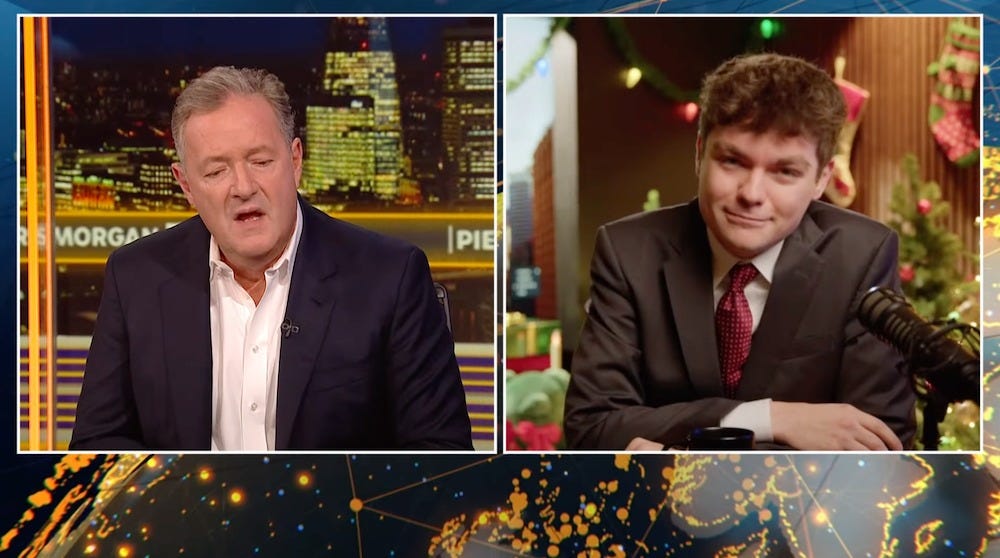
This week, the controversial young commentator Nick Fuentes – a figurehead in the online realm of ‘groypers’ – appeared on Piers Morgan’s show and wholly embraced the ‘racist’ label. The exchange went like this:
PM: But you’re basically saying, ‘yeah, I’m a racist’, aren’t you?
NF: Uh, yeah. Yeah, I’m fine with that.
PM: You’re fine with saying you’re a racist?
NF: Totally. I think everybody’s racist. I think everybody, if we’re being honest, is racist. I think everybody. The only people that aren’t racist or pretend not to be are white people, to their detriment. Everybody else is racist.
Here we are witnessing a clash of incommensurable worldviews. For those of my generation, the charge of racism is about as damaging as it gets. By the 1990s and early 2000s, society had reached a consensus that to be racist made one a pariah, and few would have thought to ask the question ‘why is racism a bad thing?’ But Fuentes was born in 1998, and for his generation the implications of the term are not so clear-cut. Not only has the accusation rarely been deployed with any accuracy in their lifetimes, but as a consequence there are now many who are willing to question the view that racism is morally wrong at all.
That this should be the case is all the proof we require that the achievements of social liberalism – supercharged by the campaigns for black emancipation, feminism and gay rights from the 1960s – have been thoroughly destabilised by the culture war. The ongoing renegotiations of the social contract, a key feature of liberal systems, had reached a kind of Goldilocks moment around the turn of the millennium. Not that racism had been eliminated – human nature makes this an impossibility – but rather that the freedom to express racist ideas came with overt societal disapproval.
Then came the woke movement, an unmitigated disaster for race relations. It encouraged young people to think of themselves first and foremost in terms of their skin colour and to judge others in the same way, thereby normalising and promoting the key philosophy of ethno-nationalism. It made sweeping and unsupported claims that racism was everywhere, concealed in ‘power structures’ that only the academic elites were qualified to detect. It demanded that we accept that all white people are racist, and that any denials of racism were proof of the charge. It pressurised companies to introduce ‘unconscious bias’ training to tease out and challenge these clandestine thoughts, even when studies repeatedly showed that these measures achieved nothing whatsoever other than to generate racial tension that wasn’t there before.
Worse still, the movement insisted on a new definition of ‘racism’ that ran counter to the broadly accepted understanding of the term. Whereas most people agreed that racism was prejudice or hatred towards individuals on the basis of their race, woke activists attempted to impose their view that it was an equation – prejudice plus power – which is why only white people could ever be racist.
Due to the institutional clout of the woke movement, particularly around 2020, online dictionaries were neglecting their responsibility to record the common usage of words and were instead – Ministry of Truth style – rewriting definitions to better reflect the new orthodoxy. This is why the Anti-Defamation League changed the meaning of ‘racism’ on its website from ‘the belief that a particular race is superior or inferior to another’ to ‘the marginalization and/or oppression of people of color based on a socially constructed racial hierarchy that privileges white people’.
Whereas liberals had urged us to tackle racism wherever it occurred, anti-liberal woke activists were conjuring racism into existence by force of will. Whereas liberals had reminded us that censorship of bad ideas only amplifies them, anti-liberals were cheering on the creation of ‘hate speech’ laws that would silence anyone expressing racist beliefs, thereby inadvertently clearing the path to the rehabilitation of racist views as socially acceptable. Whereas liberals sought to achieve a future in which people would be judged by the content of their character and not the colour of their skin, anti-liberals were trashing Martin Luther King’s famous dream as an ‘ideology of racism’.
And so now the backlash is coming, and while the popularity of Fuentes and his ilk will continue to baffle liberals like me, the woke movement has made it inevitable. The appeal of Fuentes is largely as a taboo-buster. While woke activists have destroyed the lives of non-conformists and punished speech-crime with the zeal of Tomás de Torquemada, a generation of young people have had enough of being told what they can and cannot say. Many of them will feel no racist impulses, but nonetheless take joy in espousing racist views. The facts of the Holocaust will be denied more vociferously; not because the deniers have necessarily fallen for the conspiratorial nonsense circulating online, but because they have been told that these opinions are off-limits.
Above all, racism is becoming fashionable again. Our social contract has been torn apart, and the most reactionary and darkhearted will be the beneficiaries. So although woke activists are unlikely to be reading this – given that the notion of being challenged is, to them, a form of violence – I will address them nonetheless. You wanted a world in which humankind was understood through racial categories, and in which our individual qualities mattered less than our skin colour. Congratulations: it looks like you’re about to get your wish.


Yep – and we can add “fascist” and “genocidal” to the growing list of words woke progressives have emptied of meaning by screaming them at everything. The tragedy is that all this erupted just as colour-blindness was becoming the social norm. In fact, as others have noted, it created a supply-and-demand problem for progressives, which is why they began confecting new “injustices” and the broader woke movement, and ended up sowing an economy of grievance-hustlers and taboo-peddlers in the process. All so predictable and avoidable.
All great stuff of course. But surely the most fundamental of characteristics of early groups of humans was being "tribal" - distrusting outsiders as competition or threat, or exploiting them in return where opportunity arose. So if being "tribal" is pretty natural - "we can be trusted, outsiders are an unknown quantity" - that is kind of another word for being "racist", isn't it? Except that I do appreciate that the neglected words of MLK need to be refreshed, re-praised and re-instituted in our social narratives, and also it seems to me to be perfectly possible to have a feeling of belonging to, and being proud of, your own tribe, while simultaneously recognizing how stupidly inadequate it is to judge any other "tribe" on some kind of generalized, automatic assumption of superiority, or on the irrelevance of their skin colour. Can we all get better at being a bit sophisticated about taking into account history, instinct, intellect, and evolved and civilized ways of looking at the rest of the world? (And that doesn't mean you can't say that one level and type of civilization is clearly "better" than another, and that you can't import massive numbers of people from less-developed societies without damaging your own.)