

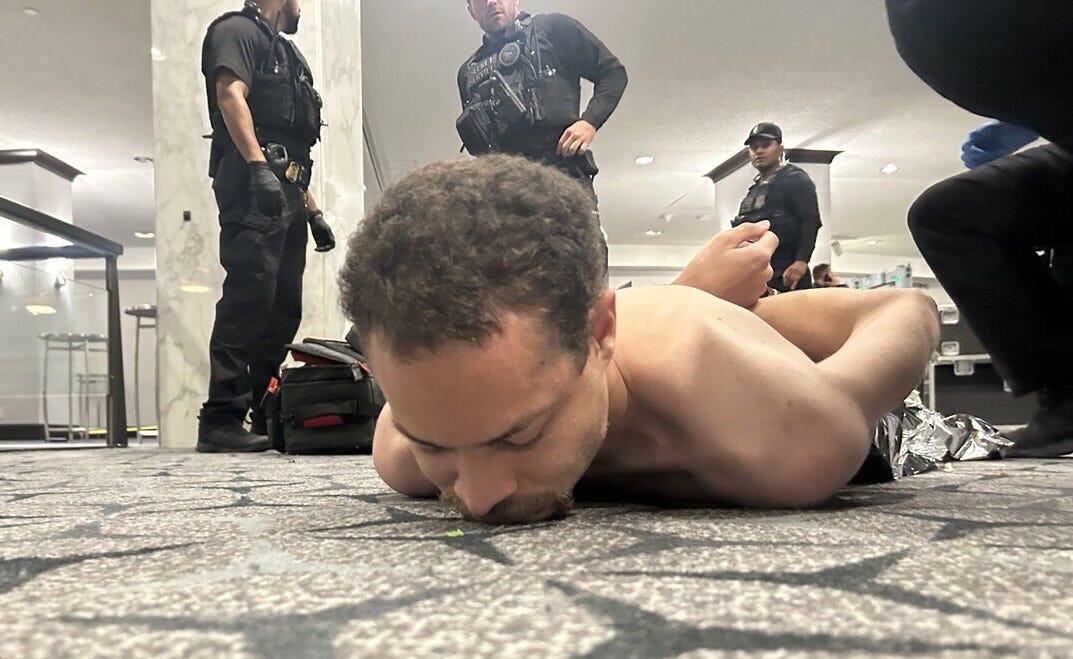
On Saturday evening, an attempt was made to storm the White House Correspondents’ Dinner. The suspected gunman is Cole Tomas Allen, a 31-year-old teacher from California, and his likely target was President Donald Trump and other figures from his administration. This is the third assassination attempt against Trump in less than two years. At this point, few would deny that political violence has become normalised. The more contentious question is what we can possibly do to reverse the trend.
Once again, the usual debates are raging online and in the legacy media. Does the left have a particular problem with violence, or is the right just as bad? Is the incendiary rhetoric of public and political figures to blame? On CNN yesterday, the political commentator Scott Jennings broached both of these questions, citing a speech this week by House Minority Leader Hakeem Jeffries in which he vowed ‘maximum warfare, everywhere, all the time’.
All such debates are understandable. The gunman at the Correspondents’ Dinner sought not only to deprive other human beings of their lives, he sought to deprive voters of their democratic rights. At times like this it is always worth emphasising that political violence is fundamentally authoritarian, a means by which an individual or group seeks to enforce their worldview on others.
But it is not helpful to explain away this behaviour as the unique tendency of a particular political tribe, or the impact of intemperate language on a malleable population. Those who have equivocated or even celebrated recent political murders – such as those of Brian Thompson, Melissa Hortman or Charlie Kirk – all share a tendency to justify violence through a process of moral reframing. There is good reason to believe that this is a sign of an increasingly infantile culture and a weak educational system.
Allen is surely a case in point. The recent ‘No Kings’ rallies – which Allen is said to have attended – saw thousands take to the streets to protest against a President who won both the popular vote and an overwhelming majority in the Electoral College. Criticism of the ruling class is healthy and necessary, but pretending that they are unelected tyrants is childish and self-defeating.
Allen apparently sent a ‘manifesto’ to his family shortly before the attack on Saturday. It is the usual sub-literate and self-aggrandising affair, but the contents are interesting for what they reveal about the anti-democratic mindset and how it seeks to justify itself. Most notably, Allen presents an argument for political violence, one that reframes it as a form of defence against tyranny.
There is nothing new in this approach, of course. It was the reason given by the conspirators against Julius Caesar, the most famous political assassination of all time. In his manifesto, Allen claims that all administration officials are legitimate targets, and calls Trump a ‘pedophile, rapist, and traitor’. This is simply an extension of the standard activist tactic of branding one’s opponents as evil in order to dehumanise them. Charlie Kirk was falsely branded a ‘fascist’ by those who defended and celebrated his murder. Feminists are routinely branded as ‘TERFs’ to excuse violence against them. This trick is as common as it is transparent.
Allen goes on to describe anyone who attended the Correspondents’ Dinner as ‘complicit’, the kind of guilt by association that we have come to expect. It’s the same logic as those activists who cancel speakers for ‘sharing a platform’ with those they have decided are beyond the pale.
Thereafter, Allen makes the standard case for political violence as a form of defence. He is not fighting for himself, he claims, but for the marginalised. This of course is the entire guiding principle of the ‘woke’ movement, which simplistically divides the world into categories of oppressor and oppressed – oftentimes misattributing each label – and poses as the defender of the latter. Allen writes:
‘Turning the other cheek is for when you yourself are oppressed. I’m not the person raped in a detention camp. I’m not the fisherman executed without trial. I’m not a schoolkid blown up or a child starved or a teenage girl abused by the many criminals in this administration. Turning the other cheek when someone else is oppressed is not Christian behavior; it is complicity in the oppressor’s crimes.’
So let’s examine his claims a little closer…
— To continue reading this article, please consider becoming a paid subscriber —
