Regime change in Iran is essential, but not guaranteed
Trump has taken the biggest risk of his presidency. But what happens next?
The end point of armed conflict is impossible to predict. In her book On Violence (1970), the philosopher Hannah Arendt argued that when it comes to political violence, ‘the means used to achieve political goals are more often than not of greater relevance to the future world than the intended goals’. However well planned and executed, wars have a tendency to spiral out of control in ways never envisaged.
Whether Donald Trump’s decision to attack Iran will pay off depends upon the fates as much as anything else. The goal is regime change, which – given the appalling tyranny under which the Iranian people have suffered for five decades – is admirable and just. Yet the numerous unknown variables make this war the biggest risk that Trump has yet taken as president.
This war has the potential to escalate and engulf the entire region. Iran is already striking neighbouring Arab states allied with the US in a scattershot and desperate manner. With the death of the Ayatollah, it may be that the regime will be forced into a ceasefire while it seeks to re-establish its power. Yet the scenes of wild celebration on the streets of Iran would suggest that domestic revolution is its greatest threat. If the Islamic Revolutionary Guard Corps (not the country’s national army, but a kind of Praetorian guard for the mullahs) can be turned, the regime will fall.
Perhaps the worst case scenario is a widespread power struggle between competing militias and separatist groups. The IRGC itself could fragment, and we may see the kind of chaos that ensued after the Iraq war of 2003. The Trump administration has the advantage of the latest military technology and will insist that this enterprise will never require ‘boots on the ground’. It may be right, but who knows what factions will emerge with no centralised authority?
Those of us without a crystal ball should get used to the phrase: ‘we don’t know’. Various social media pundits are asserting with absolute certainty where all of this will lead. They would be wise to exercise greater caution. After the Twelve-Day War last June in which Israel and the US destroyed much of Iran’s nuclear infrastructure and air defence capabilities, many on the ‘America First’ right were quick to prophesy the advent of World War III. Their claims to clairvoyance were unfounded.
But while we should keep in mind that wars never go quite as expected, we should also acknowledge that hesitation at moments of opportunity can be just as deadly. The US had several chances to kill Osama Bin Laden in the late 1990s but decided that there was no direct evidence of an imminent attack. It could be argued that, had they been less circumspect, many thousands of innocent lives might have been saved.
And of course the history books are replete with instances where the appeasement of tyrants led to further mass slaughter. The Iranian regime has proven itself to be wholly oblivious to international pressure when it comes to its grotesque human rights abuses and the development of its nuclear programme. It is estimated that over 30,000 peaceful protesters were recently slain on the orders of the Ayatollah. No wonder the people are delighted to be rid of him.
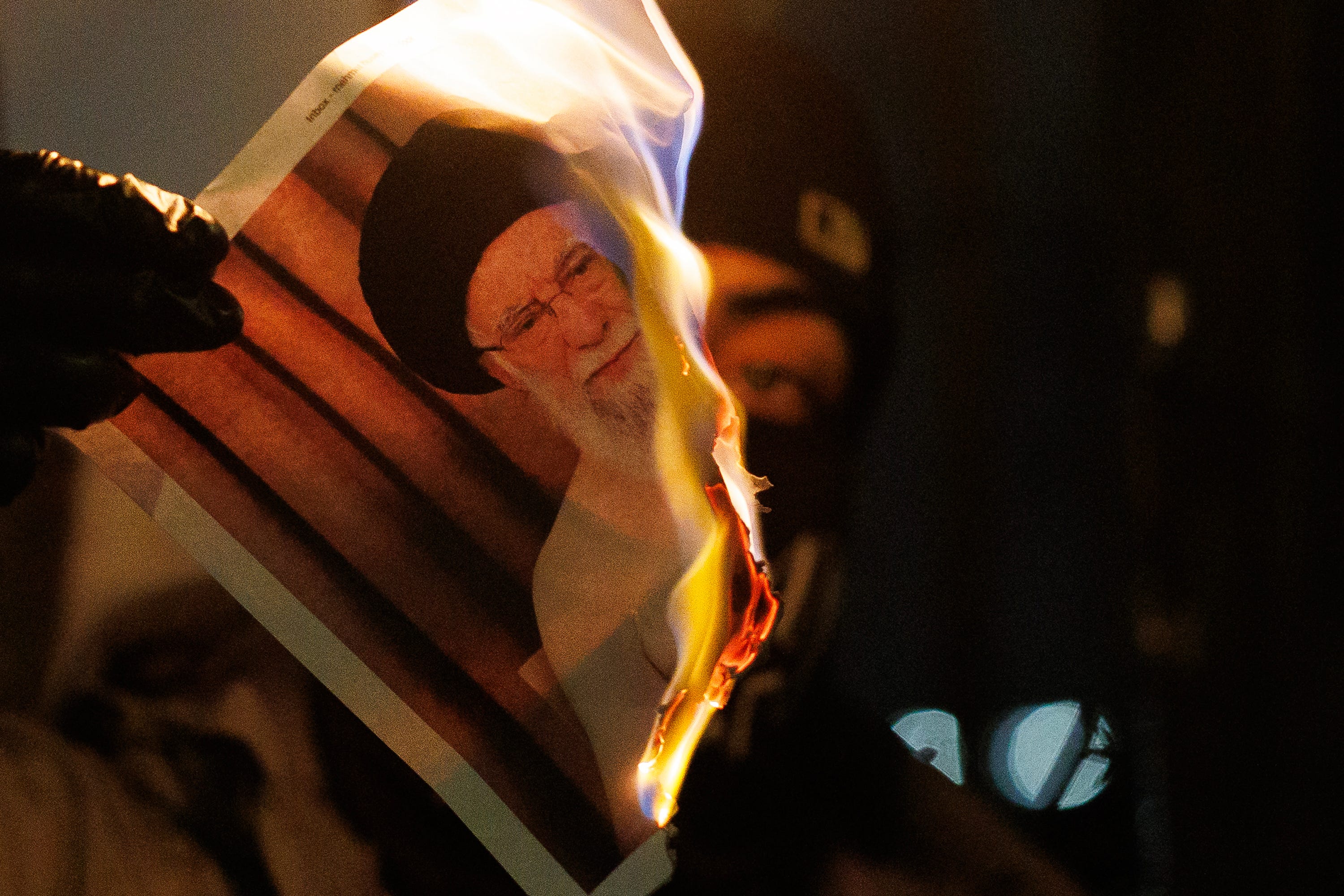
Mind you, this uncomfortable fact appears to have escaped many of the protesters who took to the streets of London this weekend. While some were doubtless opposing military intervention for principled reasons, there was a sizeable contingent who were explicitly supporting the dictatorship and, by implication, its brutal activities. Placards bearing the face of the Ayatollah with the slogan ‘Choose the Right Side of History’ could scarcely be more explicit.
Call me a milksop liberal, but if I were at a protest in which many of the attendees were openly endorsing mass-murdering Islamo-fascists, I might reflect on the wisdom of my participation. At the very least, I would challenge these cheerleaders for tyranny and make every effort to distance myself from them. There was little evidence that this was the case at these protests. If those in attendance weren’t directly supporting the regime, they were certainly prepared to tolerate those who were.
Do these useful idiots really have to be reminded that Iran has one of the highest global execution rates in the world? Or that it has tortured and executed thousands of gay people, political dissidents, journalists, and ethnic minorities such as Kurds and Baluchis? Its violent oppression of women is there for all to see, and it even has a group of thugs known as the ‘morality police’ to beat women for their ‘immodesty’. It shouldn’t be difficult to take a stance against military interventionism while simultaneously condemning the horrors perpetuated by this barbaric regime.
Ultimately, we simply do not know what the outcome will be, and we should be hesitant to make any predictions. If history has taught us anything, it’s that it cannot be directed according to any one plan. If, as many Iranians hope, the regime falls and is superseded by a democratic constitutional monarchy, we will all be living in a much safer world. It may be far too early to say whether the freedom of the Iranian people can be achieved, but there is every reason to hope.


It's an extraordinarily complex situation that's already being distorted left, right and centre in service of tribal point-scoring. Lots of unpleasant takes* polluting the Substack notes feed today (God knows what Twitter/Bluesky must be like).
Anyone paying attention knows something's going very wrong in the culture – antisemitism being a reliable barometer of these things. But mismanagement by an exhausted political class is creating space for dangerous fanaticism, especially in the UK: the kind that would rather side with clerical fascists than their critics. It's the moral certainty of these people that chills – so many of them obviously the product of indoctrination.
*Today I got called a "propagandist and fucking idiot" (lol) by a very prominent writer on this platform, and when I referred him to Simon Sebag Montefiore's brilliant piece on the Free Press (which I quoted), he angrily shot back that it's "literally funded by Israel".
These people are everywhere, gleefully waiting for everything to go horribly wrong because what matters is not peace or security in the region but feeding their own narcissism and blaming it all on you-know-who.
My questions are- what would success look like?
and what are the parallels with Ukraine being attacked by Russia?
I get the feeling that many in Britain feel that with extra commitment and force, plus the cleverness of Mossad, "we" could see an end to both Iran's state sponsored terrorism and Putin's regime with a restoration of Ukraine's sovereign borders.
I can't see that - my view being based upon history and human nature,
and even not so, if we see achieved a half way house with Iran being controlled by a western friendly government ( like the Shah's) and Putin being dead
No answers can be both realistic and also lead to peace in the Middle East.