

‘The Party told you to reject the evidence of your eyes and ears. It was their final, most essential command.’ These words are among the most frequently quoted from George Orwell’s Nineteen Eighty-Four. We see them in memes, in online arguments, repeated endlessly in opinion columns in the national press. The passage has turned into the very thing that Orwell hated the most: a cliché.
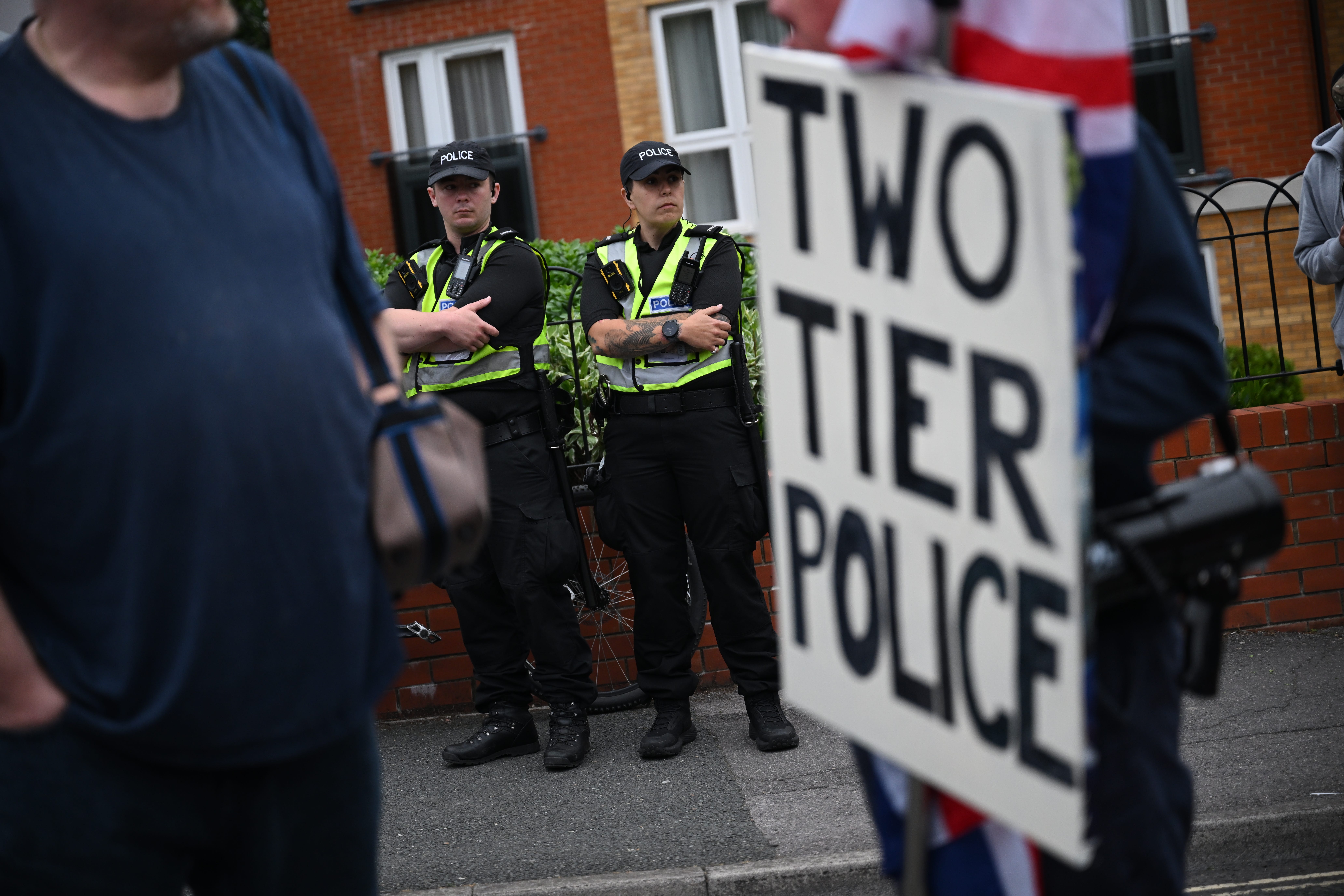
Yet ideas become clichés for a reason. So many aspects of Orwell’s novel seem prescient today, not least this tendency among authoritarians to blur the lines between truth and fiction and demand that the population play along. There is no clearer example than what has become known as ‘two-tier policing’. The evidence for it is overwhelming, and yet commentators, journalists, politicians, podcasters, activists and online loudmouths continue to deny it. Once again, the narrative has taken precedence over reality.
The notion that members of the public must be treated differently according to their group identity is not simply a speculative explanation for egregious police conduct. It is explicitly encoded in guidance published by the College of Policing and the NPCC (National Police Chiefs’ Council). There are numerous recorded interviews with officers who tell us that their job is to investigate and arrest those who have caused offence to particular groups. Multiple whistleblowers have revealed details of training sessions they have been compelled to attend that have instructed them to take a two-tier approach.
But you wouldn’t know any of this had you only read a recent article by Andy Hughes, LBC’s Crime Correspondent. Hughes argues that it is ‘nonsense to say police are told to treat people differently based on their ethnicity’ and claims to have spoken to dozens of officers who have confirmed his view. It seems odd that Hughes does not realise that there is nothing particularly surprising about officers repeating the party line. Far more revealing are those who are speaking out about two-tier policing – none of whom Hughes appears to have spoken to – in spite of the risk to their career. They’re called ‘whistleblowers’ for a reason.
Then there is the police guidance itself. Hughes attempts to shrug off the Police Anti-Racism Commitment on the grounds that he doesn’t understand it:
‘The NPCC guidance says: “Producing equality of policing outcomes for people from different ethnic groups by responding to individuals and communities according to their specific needs, circumstances and experiences.”
I’ve read this section several times, and I still don’t know what it means.
The wording is “clumsy”, as the NPCC admits, and police chiefs say they will review the guidance.
But to suggest this means every police officer is now told to treat people differently based on race is inaccurate – and dangerous.’
A generous interpretation would be that Hughes simply hadn’t read the following sentences in the guidance, which could not be clearer even for those unfamiliar with the activist jargon.
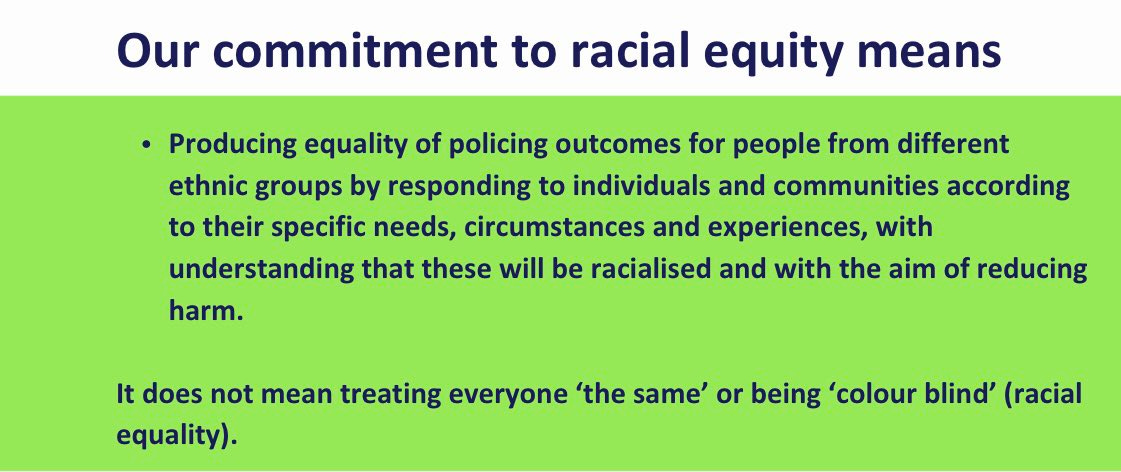
And there you have it. The ‘Police Anti-Racism Commitment’ explicitly states that officers should treat people differently based on race and that they must reject the principle of equality before the law. Their commitment to racial equity, it says, ‘does not mean treating everyone “the same” or being “colour blind” (racial equality)’. Of course, it’s unlikely that Hughes stopped reading at that point. It’s more plausible that he realised that the document flatly contradicted his narrative and decided to omit the relevant line.
However, the ‘clumsy’ language that Hughes cites (but does not understand) is evidence enough. When the guidance calls for ‘equality of policing outcomes’, it is saying that suspects should be treated differently according to their race in order to reduce disparities. It draws on a principle of Critical Race Theory, that equality of outcome is evidence of unequal treatment. As Ibram X. Kendi puts it, ‘racial inequality is evidence of racist policy’.
It’s the same logic that prevented Valdo Calocane, a paranoid schizophrenic, from being sectioned by the NHS. Having perpetrated a violent crime, mental health staff did not detain him because they were concerned about ‘over-representation of black men’ among those committed. They were simply following the NHS guidelines, but Calocane went on to murder two teenagers and an older man in June 2023. When ‘racial equity’ is adopted as policy, it costs lives.
Let’s have a closer look at the evidence of institutional capture as reflected in the official police guidelines…
— To continue reading this article, please consider becoming a paid subscriber —
