


Yesterday saw the anointment of Andy Burnham as our new Prime Minister. He had not worked in parliament for over a decade, has no serious mandate from the public to lead the country, and has been helicoptered in by his colleagues in the hope that he can recover what is left of the reputation of the Labour Party. Given that Keir Starmer has presided over the most authoritarian government in living memory, is it possible that Burnham will see the error of his predecessor’s ways?
The early signs are not good. Burnham has already appointed two staff members from Hope Not Hate, a militant leftist organisation that has a habit of smearing people with mainstream opinions as ‘far right’. And the Telegraph has now revealed that a new report commissioned by the Government Office for Science early this year and published in May could end up influencing the Burnham government’s future direction on online misinformation and issues relating to free speech. It offers a guide to what it calls ‘psychological inoculation’ of the public. In other words, how to play mind games and manipulate the great unwashed into behaving themselves.
If Burnham has any sense at all, he will denounce this report at the earliest opportunity. Its fundamental ethos is illiberal and anti-democratic. It is called False and Misleading Information: An Evidence Summary and Map for Policy and Practice, and it was produced by a consortium called Behavioural Research UK. It is without a doubt one of the most chilling and authoritarian documents that has ever been commissioned by a British government. It’s worth looking closely at its contents, because it might well become a roadmap for Burnham’s policies.
The report is Orwellian not simply in its recommendations, but in how it presents itself. The authors repeatedly describe it as an ‘evidence review’, but it actually contains numerous policy recommendations. Perhaps the most egregious is the suggestion that the public should be ‘inoculated’ against misinformation through a process of ‘prebunking’; a sinister euphemism for censorship. It describes prebunking as the ‘first line of defence’. Here is the relevant passage as it appears in the report:
‘Prebunking refers to a broad category of strategies aimed at stopping people from accepting false and misleading information before they encounter it. The most widely employed of these strategies is psychological inoculation, the core idea is that presenting someone with a weakened form of a misleading claim builds psychological resistance against future manipulation. Psychological inoculation typically consists of two elements: alerting someone in advance that their beliefs may come under attack (e.g., “warning: someone might try to influence you by claiming X”), and offering a preemptive counter-argument that undermines the false claim before it takes hold (e.g., “this is misleading, because Y”; van der Linden, 2025).’
The report offers vague guidance to the government on how to psychologically manipulate the public so that it is not susceptible to ‘misinformation’. It does not address the key problem: that ‘misinformation’ is often the term used by those in power to describe information that is accurate but inconvenient. The report does not consider the ethical aspects of treating the public like toddlers who can be tricked into certain modes of behaviour. Moreover, it refuses to specify how the manipulation might work in practice.
Let’s take one of the policy suggestions: ‘Game-based inoculation interventions’. One assumes that this is referring to computer games produced for schools and workplaces. We’ve seen this kind of nonsense from the Labour government before. Back in January, the Telegraph reported on the state-funded Pathways game, aimed at secondary school children and sixth form students, that warned them that questioning mass migration could result in a referral to the counter-terrorism unit.
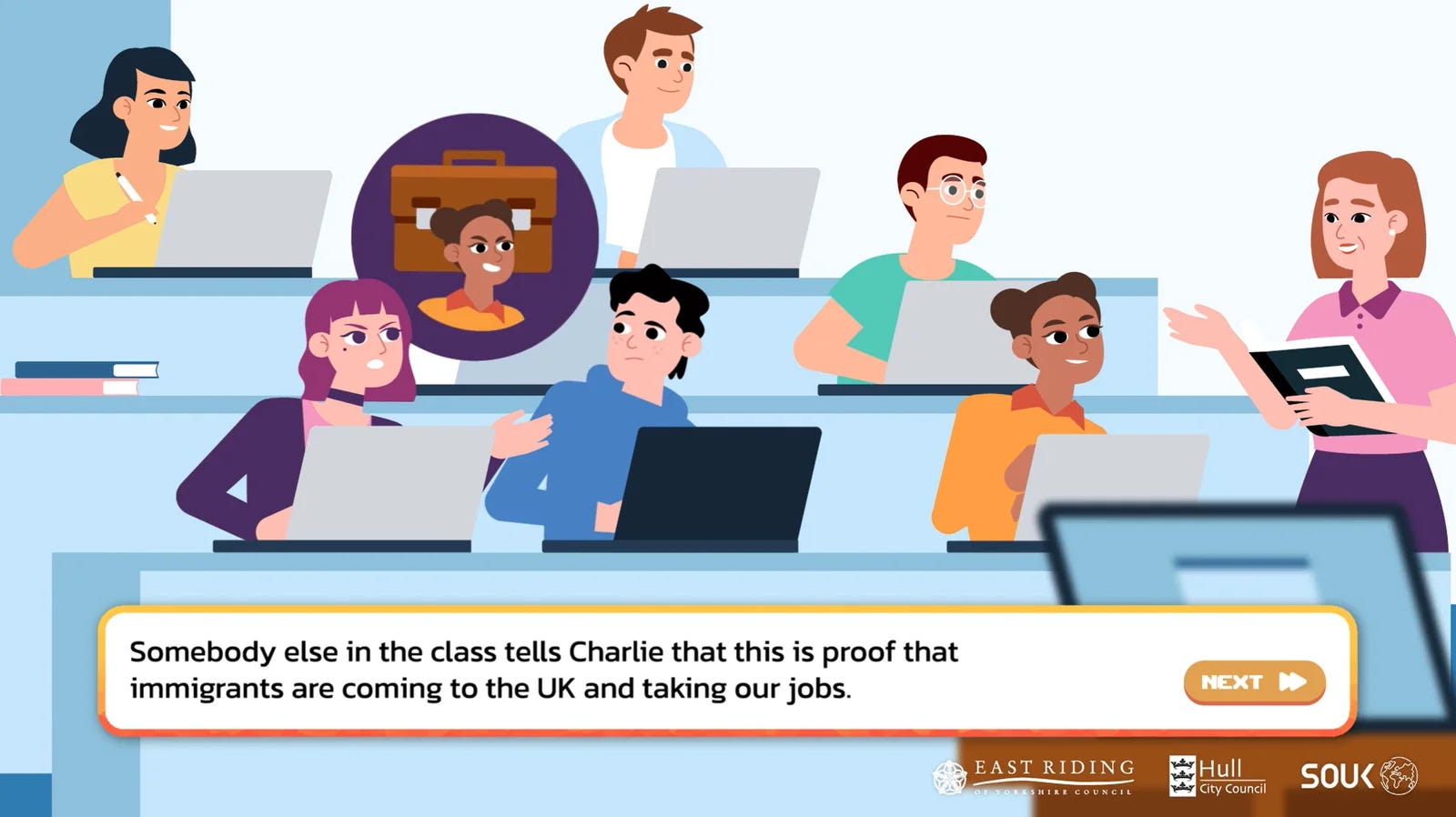
It features a character called Charlie (pronouns they/them, naturally) who is lured onto the slippery slope of radicalisation by watching online videos. It’s difficult to decide which is more cringemaking: the game itself, or the government’s faith that such overt propaganda will have the desired effect.
We see the same paternalistic philosophy in this recent False and Misleading Information report, an attitude that evidently mirrors that of Burnham’s government…
— To continue reading this article, please consider becoming a paid subscriber —
