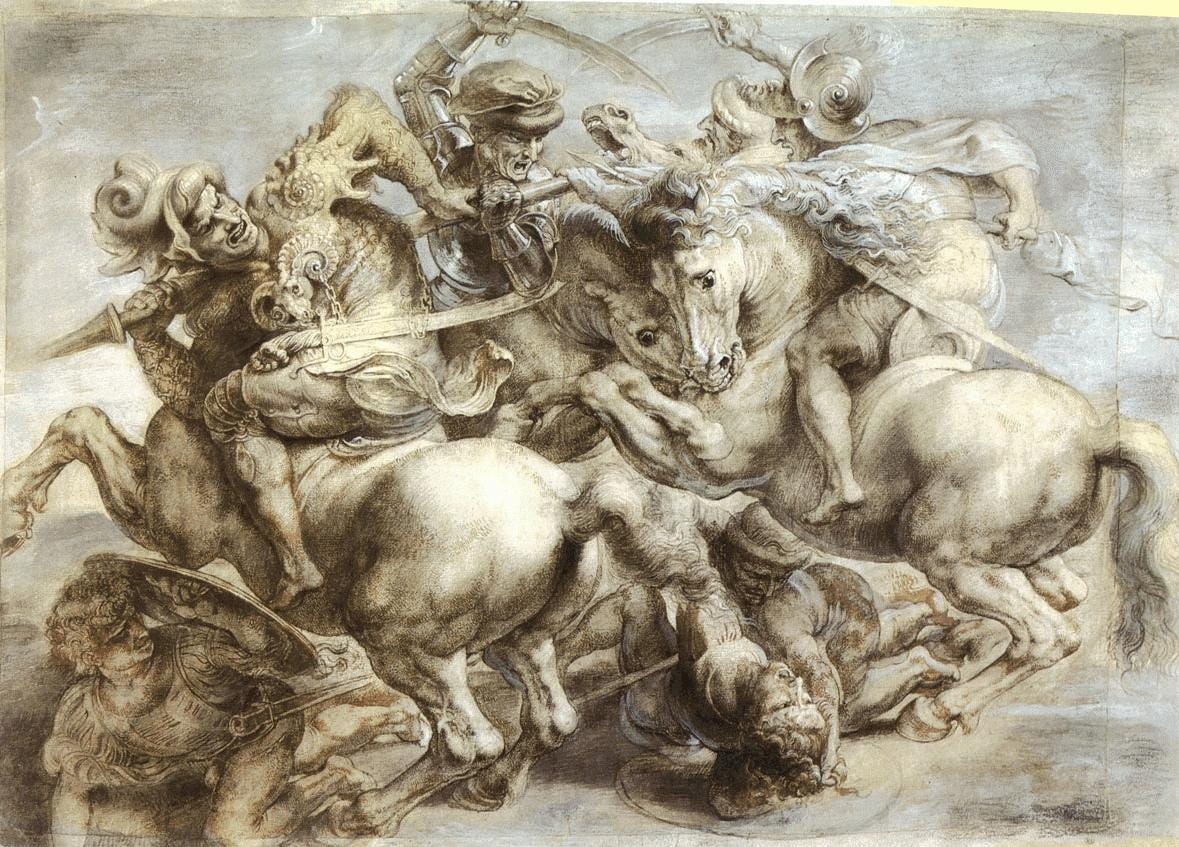
The lost Leonardo
‘The Battle of Anghiari’ once adorned a wall inside the Palazzo Vecchio in Florence; why does the art establishment continue to deny it?

On Friday 6 June 1505, Leonardo da Vinci was in the Sala Grande (Great Hall) of the Palazzo Vecchio in Florence, poised to begin his masterpiece ‘The Battle of Anghiari’. It was to depict the famous clash between the armies of the Republic of Florence and Milan in 1440 in which the Florentines emerged triumphant. His preparatory cartoon was ready; all that remained was to paint the image on to the wall itself.
But the night was full of omens, and something went badly wrong. We know this because of a short account that Leonardo wrote in his notebooks, penned in his habitual mirrored lettering (right-to-left, probably because he was left-handed and wanted to avoid smudging the ink). It says:
‘Addì 6 di giugno 1505, in venerdì, al toco delle 13 ore, cominciai a colorire in palazo. Nel qual punto del posare il pennello, si guastò il tenpo e ssonò a banco, richiedendo li omini a ragione. Il cartone si stracciò, l’acqua si versò, e rupesi il vaso dell’acqua che ssi portava. E subito si guastò il tenpo e piovve insino a ssera acqua grandissima. E stette il tenpo come notte.’
‘On the 6th June 1505, a Friday, at the stroke of the thirteenth hour, I began to paint in the palace. At the moment of applying the brush, a storm broke and the bell started to toll, calling the men to court. The cartoon was torn, the water spilled, and the jar carrying it was broken. And suddenly the weather worsened and it rained heavily until evening. And it was as dark as night.’
According to the memoirs of the sixteenth-century historian Bartolomeo Cerretani, Leonardo took up his brush again a few months later. He never finished the work, but for more than half a century the one aspect of the mural that Leonardo had partially completed – a striking image of horses and soldiers colliding in battle, approximately five metres wide and three metres high – was admired by artists and visitors who travelled to the Palazzo Vecchio to witness it for themselves. We can still catch glimpses of its majesty in the various copies that survive, most notably the one by Rubens (see image above).
As late as 1549, the writer Anton Francesco Doni was praising the beauty of the unfinished mural:
‘e salito le scale della sala grande, diligentemente date una vista a un gruppo di cavalli, e d’uomini (un pezzo di battaglia di Lionardo da Vinci) che vi parrà una cosa miracolosa.’
‘and having climbed the stairs of the great hall, diligently take a look at a group of horses and men (a battle piece by Leonardo da Vinci), which will strike you as a miraculous thing.’
However miraculous it might have been, it was destined for destruction. In the 1560s, the Duke of Florence Cosimo I de’ Medici commissioned the artist Giorgio Vasari to redecorate the hall entirely. Vasari’s murals now cover the entirety of both the east and west walls of the Sala Grande. His admiration for Leonardo was so extreme that it verged on deification, and this has led many art historians to assume that he must have found a method to protect this renowned masterwork. Surely he wouldn’t simply allow it to perish?
And this is where the story begins to resemble detective fiction. Research into the archives has roughly determined the location of Leonardo’s lost painting. It just so happens to match the exact area where Maurizio Seracini, an engineer with expertise in multispectral imaging, discovered a gap of up to four centimetres behind the wall. This led him to propose that Vasari had created a second wall, a kind of membrane to conceal the master’s painting rather than consign it to oblivion.
Vasari had done something very similar when renovating the church of Santa Maria Novella in Florence circa 1568. Instead of destroying Masaccio’s Holy Trinity, he covered it with a new altarpiece. This work, much admired by Vasari, was only rediscovered in 1860 during construction work in the church. It is surely not inconceivable that Vasari would repeat the technique in the Palazzo Vecchio to protect an even more valuable piece.
Tantalisingly, Seracini also discovered a small motto painted by Vasari on his fresco of the Battle of Marciano, too high to be read from the ground, which appears precisely at the location of the cavity where the Leonardo might still exist. It says: ‘cerca trova’. He who seeks, finds.

I have written about this curious story only once before, in an article for the Washington Post. I am returning to it now because I am interested in what it reveals about how some academics are prone to favour fiction over fact if it serves their political or ideological purposes. For centuries, the fact that Leonardo had painted a fragment of The Battle of Anghiari was uncontested. It was only in the early 2010s that the consensus in the art establishment shifted to the view that the image had only ever existed in cartoon form. This sea change coincided with Seracini’s findings, likely because art historians were concerned that he might continue to drill through the Vasari fresco in the hope of uncovering the lost Leonardo.
It’s a valid concern, but it doesn’t explain why leading academics are now denying the historical records that quite plainly tell us that the painting once existed. Let’s take a response to my Washington Post article written by Francesca Fiorani, professor of art history at the University of Virginia. In her letter, Fiorani rigorously defends the establishment line. Here is the letter in full:
‘Andrew Doyle’s Feb. 7 Friday Opinion essay, “Behind a false wall, a lost Da Vinci might lurk,” seemed to be based more on obsession than evidence.
It rehearsed controversies, carefully retraced to 1968, pertaining to the search of Leonardo da Vinci’s “Battle of Anghiari” behind a wall of the Salone dei Cinquecento (Hall of the Five Hundreds) at Florence’s Palazzo Vecchio. He also reported the various attempts that, from 1968 onward, were made to recover Leonardo’s lost battle: large sections of the frescoes Giorgio Vasari painted in the Hall of the Five Hundreds were stripped down, but nothing was found; holes were drilled into Vasari’s frescoes on the opposite wall, but nothing was found there, either; later, more holes were drilled to send in a camera to inspect what was behind Vasari’s frescoes and collect sample materials from the wall, but all that was found was a small interspace — a common feature of walls constructed then — and pigments that were common to medieval and Renaissance paintings.
The fact that nothing unusual emerged that could be construed as evidence of Leonardo’s lost battle should weigh heavily on the question. But there is also all the fact-based research that did emerge in those same years, including new analysis of Renaissance building materials and techniques, and fresh study of literary sources and documentation on Leonardo’s art. By 2019, most experts agreed that Leonardo drew two full cartoons representing the battle, that he acquired materials to prepare the wall to paint on it, that something went wrong in the preparation of the wall and that, consequently, he did not paint anything on it.
Unfortunately, Doyle dismisses the view against his position as “sheer dogmatism” of academics who are “almost certainly wrong.” Instead, he favored the single-minded view of Maurizio Seracini, an engineer who specializes in art diagnostics and has developed a half-century obsession with “The Battle of Anghiari” — an obsession that blinds him to the strength of all the contrary evidence.
Francesca Fiorani, Charlottesville’
There are many odd aspects to this letter. Most notably, Fiorani appears to believe that my choosing to write one article about Leonardo in a writing career that spans two decades amounts to an ‘obsession’. Now that I’m writing a second, no doubt Fiorani will maintain that I have veered into the territory of the crazed monomaniac. Still, let’s leave that curiosity aside.
She mentions that ‘nothing was found’ during Seracini’s investigative process. In fact, samples of pigment were retrieved which seemed to tally with those used by Leonardo in the Mona Lisa and Saint John the Baptist. Fiorani weaves around this by dismissing the samples as ‘common’.
She goes on to mention ‘the fact-based research that did emerge in those same years’, as though I hadn’t addressed these sources exhaustively in the article itself. Contrary to Fiorani’s remarks, I accurately summarised the conclusions of these academics, and quoted at length from their 2019 anthology of essays La Sala Grande di Palazzo Vecchio e la Battaglia di Anghiari di Leonardo da Vinci, a 600-page tome that I have diligently read and digested. How could Fiorani have missed this? The generous conclusion is that she was in a rush and had only skim-read those aspects of my article.
But then comes the real sleight of hand. ‘By 2019,’ she writes, ‘most experts agreed that Leonardo drew two full cartoons representing the battle, that he acquired materials to prepare the wall to paint on it, that something went wrong in the preparation of the wall and that, consequently, he did not paint anything on it.’ This is, of course, precisely the untenable academic consensus that I am criticising. Fiorani has not lied; the art establishment as a whole genuinely maintains that Leonardo did not begin painting the mural. What she omits is that all the extant evidence tells us that this is factually wrong.
I have already quoted in my Washington Post article the various testimonies from the sixteenth-century of those who saw for themselves the mural on the wall of the Palazzo Vecchio. To avoid repetition, I’ll limit myself here to an example that I did not quote in my article, but which is perhaps the most revealing. This is from the memoirs of Bartolomeo Cerretani, written just a few months after Leonardo began his work.
‘In questo tempo Lionardo da Vinci, maestro grandissimo et fiorentino di pittura, cominciò a dipignere la Sala del Consiglio in quella faccia sopra dove stanno e 12 Buoni Huomini, et fessi amattonare quel’andito del Palazzo in Sala con matoni quasi tonddi, et apichòsi in Sala detta nove bandiere toltte al signore Bartolomeo d’Alviano più giorni fa.’
‘At this time Leonardo da Vinci, a very great and Florentine master of painting, began to paint the Hall of the Council on that wall over where the Twelve Good Men are; and that hallway from the Palace to the Hall was caused to be paved with nearly round bricks; and nine flags taken from Lord Bartolomeo d’Alviano a few days ago were hung in the said Hall.’
Not only does Cerretani specify the location (corresponding to the ‘cerca trova’ motto on the Vasari fresco), but he specifically confirms that Leonardo resumed work directly on the wall. The word faccia means the inside wall, whereas facciata would be an outside wall such as the façade of a church. Faccia is simply never used to denote a cartoon (cartone) or preparatory drawing. The phrase cominciò a dipignere unequivocally means he ‘began to paint’. Fiorani and those other academics who are insistent on perpetuating the myth that Leonardo’s work only ever existed in cartoon form will have to prove that Cerretani – and the many others who wrote of the painting at the time – were hallucinating.
Fiorani has ignored all of these testimonies in her response, presumably because they are inconvenient to her narrative. She did not even mention the reference to The Battle of Anghiari by the physician and historian Paolo Giovio, Bishop of Nocera, in a biography of Leonardo written in Latin around 1528. As I pointed out in my piece for the Washington Post, Giovio clearly states that the picture survived in the Sala Grande at this time:
‘Manet etiam in Comitio Curiae Florentinae pugna atque victoria de Pisanis praeclare admodum, sed infeliciter inchoata vitio tectorii colores juglandino oleo intritos singulari contumacia respuentis. Cujus inexpectatae (injuriae) justissimus dolor interrupto operi gratiae plurimum addidisse videtur.’
‘The battle and victory over the Pisans still remains in the Council Hall of the Florentine Republic, most excellently begun but unfortunately marred by a defect in the plaster, which rejected the colours mixed with walnut oil with singular defiance. The justified grief caused by this unexpected damage seems to have added a great deal of grace to the unfinished work.’
Now we come to another disturbing tactic by denialist academics. In the 2019 anthology, a book whose intention is to settle the matter once and for all and prevent any further investigations at the Palazzo Vecchio, the above passage by Giovio is quoted by art historians Roberto Bellucci and Cecilia Frosinini (albeit confined to a footnote). However, they omit the two key words: ‘Manet etiam’ (‘It still remains’).
Was this an innocent mistake? A mistranscription? It could hardly be a space-saving exercise; two more words would have made little difference in a volume of 600 pages. It is surely relevant that Bellucci and Frosinini’s central argument is that The Battle of Anghiari only ever existed in cartoon form. The omission of these words in the quotation from Giovio significantly changes its meaning. As quoted, it could be interpreted as suggesting that the charm of the unfinished cartoon was accentuated by our knowledge of the fate of the mural. With the omitted words restored, it is clear that Giovio is referring to an extant mural whose defects have enhanced its appeal.
All of which brings us on to the key question. These academics are fully aware of the historical sources. They know that many of them refer to a painting that once existed on the wall of the Sala Grande. Yet they are going to great lengths to deny this. So does that mean that they are lying?
I am not so sure. There is a term for when experts mislead the public out of good intentions; it is called ‘noble cause distortion’. In this case, no doubt the art establishment is trying to protect the Vasari fresco from any damage that might ensue with further testing of the hidden cavity. They do not deny the existence of the evidence I have quoted, but tend to work around it, either selectively quoting or not quoting it at all. It is possible that they have convinced themselves that the evidence does not matter. Or perhaps having staked their professional reputations on such a dogmatic position, they cannot now allow themselves to consider that they might have got it wrong.
So let’s reiterate the key facts of the case. The available sources show that The Battle of Anghiari did once exist on the wall of the Palazzo Vecchio, and that in spite of its degraded condition it was much admired for its beauty and style until Vasari’s renovations of the 1560s. We know that Vasari had previously protected a great work of art under such circumstances, and would likely have done the same for the Leonardo if it were possible. We also know (thanks to Maurizio Seracini’s work) that a cavity exists behind the Vasari fresco at the very location where Leonardo’s painting was once located, and that Vasari had written ‘cerca trova’ at the same spot in letters too small to be seen from ground level.
All this considered, there is no sound reason not to undertake a fresh investigation at the Palazzo Vecchio. Since the project was abandoned in 2012, non-invasive imaging technologies have advanced to such a degree that a search behind the Vasari fresco could be undertaken with far greater clarity and no drilling. The AI revolution will make the investigations far more efficient. To prove the point, just read this entirely AI-generated proposal for precisely how this investigation might be undertaken, including an estimation of the overall cost.
I am not claiming that Leonardo’s mural definitely still exists. It might have been destroyed entirely during Vasari’s initial renovations. It might have decayed to such a degree that what remains is worthless. But there is also a chance that this masterpiece could be recovered. We finally possess the tools to resolve this mystery without risk; all we lack is the courage to use them. The Florentine authorities need to stop kowtowing to academics who have dispensed with the facts for the sake of an agenda.


What a fascinating piece.
I agree that the art world have a vested and justifiable interest in preserving the art that was painted over Da Vinci's but it's hard to believe the lengths some people will go to in order to achieve this.
If this is happening in the art world, amongst academics who have the time and privilege to stydy in detail, one can assume that its happening in other academic disciplines too.
Its basically a mistrust of 'little man', whose judgement academics think is severely lacking.
Why not just tell us the truth and let the people decide whether to continue searching or not? Surprisingly we are actually capable of rationale thought and can understand nuance.
This is so typical of elites, whose worldview is such that they elevate themselves above the great unwashed and feed us the selected tidbits they think we can digest whilst hiding facts for their own convenience.
Lab leak? Don't be a conspiracy theorist.
Masks can't prevent microscopic viruses entering your mouth? Don't be ridiculous.
Humans can't change sex? You're obviously biologically illiterate.
I can't believe how naive and trusting I used to be, viewing academics as the font of all knowledge and bowing to their opinions. It's taken a few decades for the scales to fall from my eyes but once you see their patronising stance its impossible to ignore it.
(I don't suggest all academics are patronising but they are all human and vulnerable to bias etc.)
Thank you Anfrew for your painstaking and diligent writing and for reminding us all that the 'noble distortions of truth' are undermining trust in our society. '
Andrew, not another one of your "obsessions"? An "obsession that blinds him to the strength of all the contrary evidence"? I see a parallel "obsession" here. Behind the carefully constructed façade of medical consensus on "gender affirming care" is the truth .