One of life’s small pleasures is the uncanny sensation of exploring a place previously encountered only in fiction. Those who have read Howards End by E. M. Forster will remember the vivid descriptions of the old property that Mrs Wilcox so adored. But are they aware that it exists in the real world in the form of Rooks Nest House near Stevenage? Similarly, fans of James Joyce’s Ulysses can step into Buck Mulligan’s shoes by visiting the Martello tower where he lived, still standing today at Sandycove just south of Dublin.
Locations that have been immortalised in novels tend to inspire a chill of familiarity. On a recent trip back to England I took one of my favourite country walks to another literary landmark. My house is not too far from Wallington, the village where George Orwell lived and worked from 1936 to 1940. It was here that he conceived Animal Farm (1945), and it was only by walking there myself that I discovered there is an actual ‘Manor Farm’ – the apparent model for the farm in the novel – just a few hundred metres from where the great man lived.
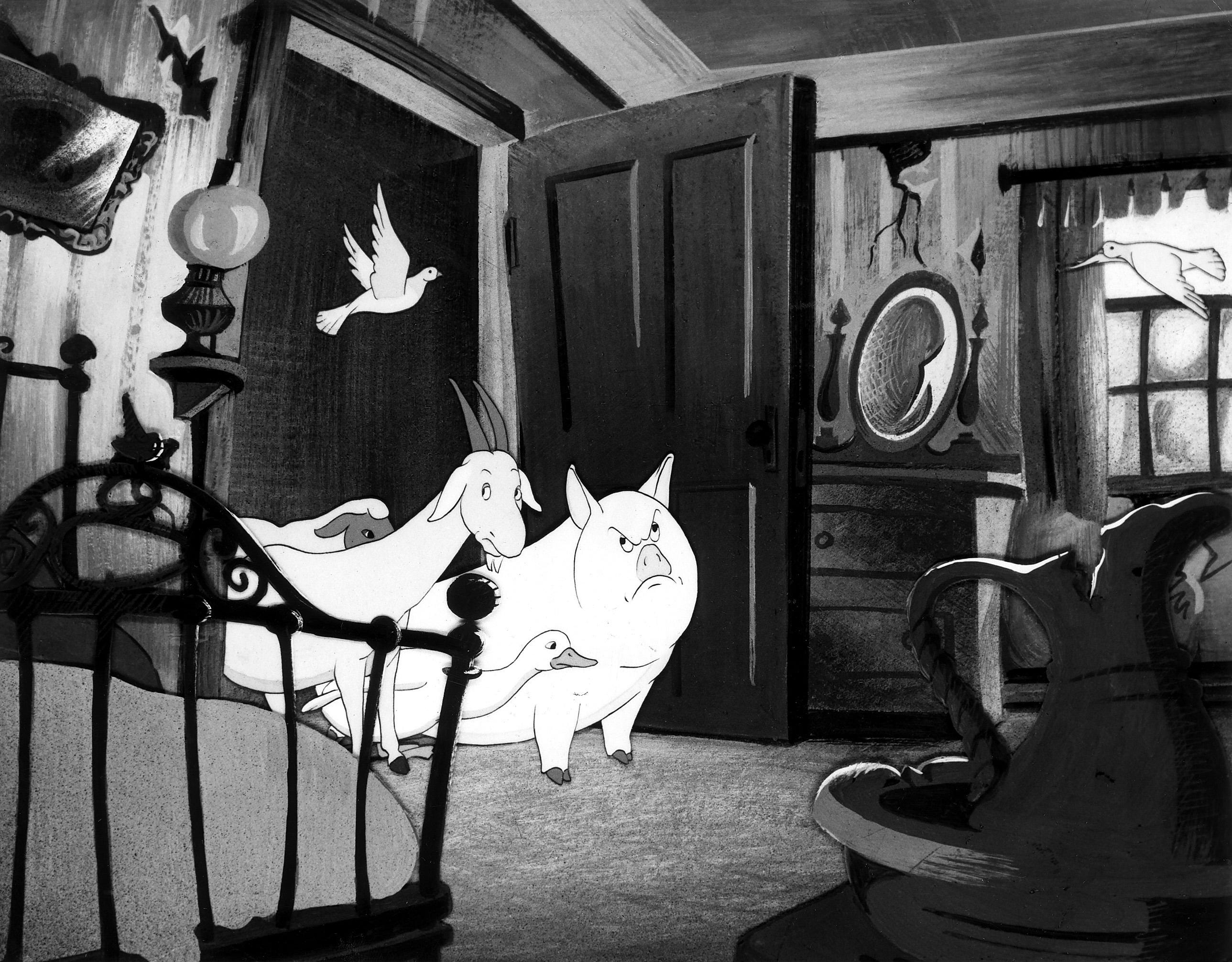
The story opens with the farmer, Mr. Jones, locking up the hen houses for the night and making his way up to bed. Then the protagonists of our ‘fairy story’ are introduced…
‘As soon as the light in the bedroom went out there was a stirring and a fluttering all through the farm buildings. Word had gone round during the day that old Major, the prize Middle White boar, had had a strange dream on the previous night and wished to communicate it to the other animals. It had been agreed that they should all meet in the big barn as soon as Mr. Jones was safely out of the way.’
There follows Old Major’s famous speech to the animals in which he lays out his dream of revolution. The ‘big barn’ remains to this day and is the first structure of Manor Farm that one sees from the road. The farm is still working, so I was reluctant to risk trespassing to see whether it still contains the raised platform from which the mighty beast – a porcine Lenin – delivered his oration. Still, it’s definitely there. It’s big, it’s a barn, and to settle all ambiguity it bears the sign of ‘Manor Farm’.


It’s worth a visit. There’s not so much as a pub in the village itself and, with its population of one hundred and fifty, you’ll be noticed if you start taking photographs. But walking along those lanes to the faint trilling of birdsong, it’s easy to find oneself momentarily seeing the village through Orwell’s eyes.
Orwell’s cottage on the corner of Kits Lane has a small plaque to commemorate his time there. This late seventeenth-century property used to be called ‘The Stores’ because it was once a local shop. Orwell and his wife Eileen sold groceries here, as well as sweets and packets of aspirin. The income helped to offset the rent, and afforded him time to write in peace. If you do manage a visit, take note of the low front door. Orwell, being a tall man, would often bang his head against the ceiling.


The couple kept chickens and a goat and tended their garden. It was in this building that Orwell wrote The Road to Wigan Pier and Homage to Catalonia. His time in Wallington was interrupted when he left to fight the fascists in the Spanish Civil War and took a bullet in the throat for his trouble. Unlike many political commentators today, Orwell knew what fascism really meant, and loathed those who bandied the term around and degraded it ‘to the level of a swearword’.
The farm is halfway between ‘The Stores’ and St Mary’s Church, where the couple married. The building itself dates back to the fourteenth century, although there was a church on this site at least as far back as the reign of King Richard the Lionheart. As with so many of these small village churches, the doors are usually open, so you can wander in and look at the small display to Orwell and a range of his books. You can also buy a guide to ‘Orwell’s Life In Wallington’ by leaving the money in the basket. It’s a small reminder of the high-trust society that was once taken for granted.


Already I see myself falling into the trap of sentimentality, a quality that Orwell despised, but in my defence it is very difficult for a visitor in 2026 not to be captivated by this sliver of a lost world. And why should we not be inspired? Orwell certainly was. Having returned to Wallington from Spain, a simple event took place that proved to be the germ of Animal Farm. He recalled the moment in the preface to the Ukrainian edition of 1947:
‘On my return from Spain I thought of exposing the Soviet myth in a story that could be easily understood by almost anyone and which could be easily translated into other languages. However, the actual details of the story did not come to me for some time until one day (I was then living in a small village) I saw a little boy, perhaps ten years old, driving a huge cart-horse along a narrow path, whipping it whenever it tried to turn. It struck me that if only such animals became aware of their strength we should have no power over them, and that men exploit animals in much the same way as the rich exploit the proletariat.’
That boy was not to know that he had inadvertently changed the course of English literary history. There may not be much to see in Wallington, but it remains one of those little portals where one can step from reality into the world of fiction.


Although I am no fan of Ayn Rand, she did get it right about left and right being no better than two gangs squabbling over which one was to get the spoils. Orwell appeared to have agreed as Winston was tortured by O'Brien, declaring Nazis and Communists, for all their protestations were the same, solely interested in power for its own sake. ('Power is power')
The dull dispute about whether he was left or right denies that his view evolved to settle shortly before his death, after completing 1984. Disillusionment can be most fundamental- seeing how Soviet interests exploited volunteers happily executing those who did not conform. The brutal Utilitarianism behind ideology's prime objectives of survival and spread must have come as a shock. Then a bullet, putting the cherry on the cake.
Orwell's work may belong in literature. Astonishingly, despite being banned in most authoritarian and ideological regimes, his is still absent from university politics courses. That's how far we have fallen. Echos of presence, written or in films, can be wonderful to hear.
On a business visit to Japan I visited a seaside town south of Tokyo, in a way a mini version of a cross between Atlantic City and Blackpool, solely to feel the presence I had seen in a film called Tokyo Story. I searched in vain for the place where the old couple, abused by their children, looked out over the City wondering how it was possible for people to find their way around such a vast place.
Thank you. You reminded me of then, their presence and echo.