

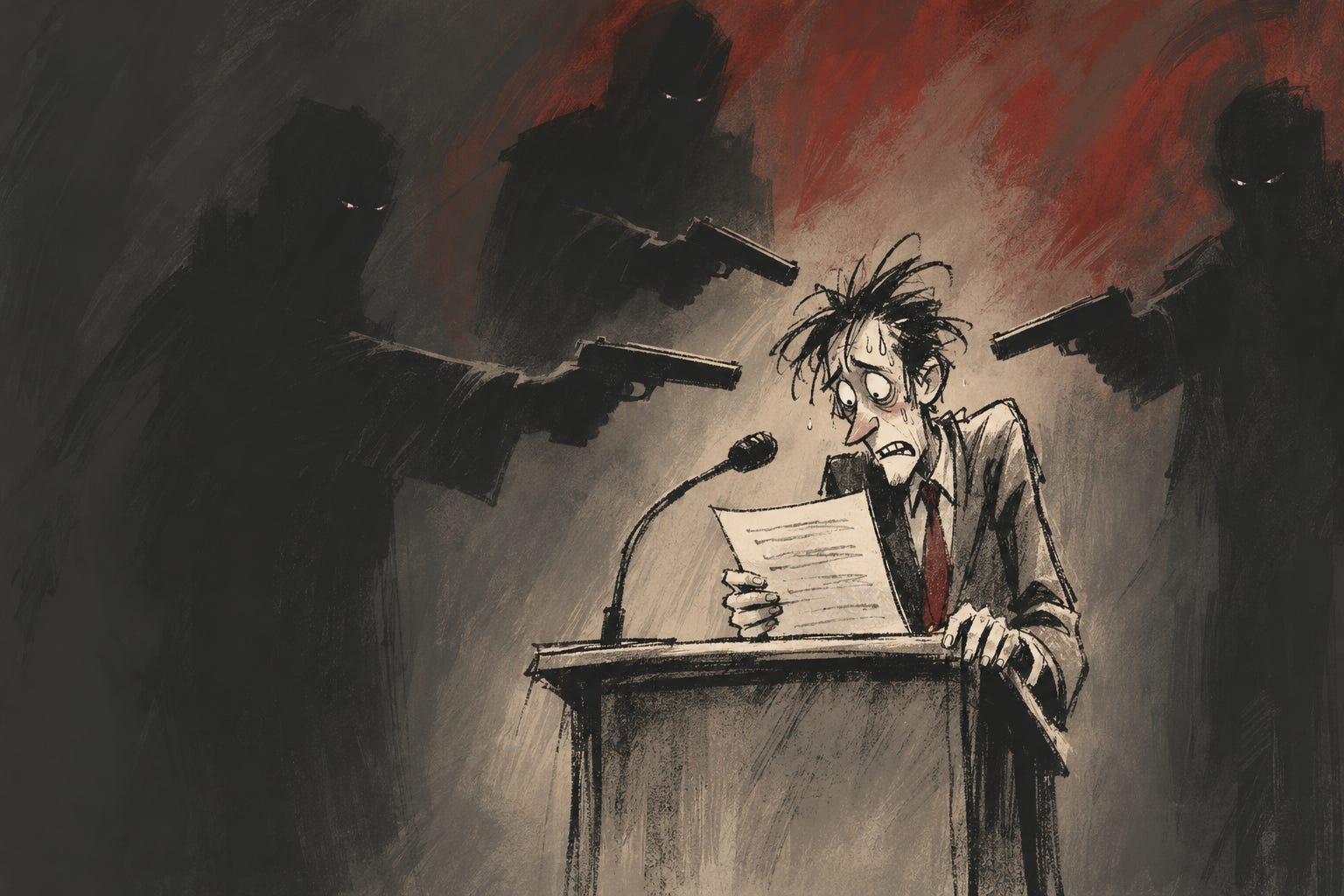
It is a common feature of dictatorships that the citizens under their control are forced to speak the approved words. This can take the form of party slogans, praise for the leader, ritual declarations of loyalty or the repetition of various ideological mantras. The purpose is not simply to prevent dissent, but to compel participation in the lie.
Spinoza understood the danger. He argued that for any man to ‘be compelled to speak only according to the dictates of the supreme power’ is a grievous contravention of his ‘indefeasible natural right’ to be ‘the master of his own thoughts’. In our debates about free speech, we tend to become so preoccupied with protecting the right to say what we want that we overlook the corresponding tendency of authoritarians to insist that we say what they want.
There have been two news stories this week that illustrate the danger of compelled speech. The Committee for Academic Freedom has intervened on behalf of two senior academics at Queen Mary University of London who have refused to complete mandatory training on ‘unconscious bias’. The disputed assessment forms part of a course called ‘Introducing Inclusion’, which the university describes as mandatory for all staff.
In order to pass, participants are required to affirm, among other things, that ‘unconscious biases help us to react quickly but can cloud our judgement’, and that it is helpful to accept that ‘we have unconscious biases’. The pass mark is 80%, but anyone who refuses to affirm both propositions can score no more than 60%. In other words, the only way to pass the test is to subscribe to contested theories about human psychology.
This is an explicit case of compelled speech. As the Committee for Academic Freedom pointed out in a post on X, passing the test is ‘a condition of eligibility for promotion, professorial review, including decisions on remuneration, and participation in recruitment and promotion panels’. It is no trivial matter when being honest is deemed a bar to advancement in one’s career.
Moreover, the evidence tells us that unconscious bias training can produce results that run counter to its intended aims. A 2019 systematic review concluded that ‘many interventions have no effect, or may even increase implicit biases’. Frank Dobbin and Alexandra Kalev reached a similar conclusion in the Harvard Business Review, noting that the effects of diversity training ‘rarely last beyond a day or two’ and that some studies suggest it can ‘activate bias or spark a backlash’.
But there is a more fundamental liberal principle at stake. Employers are perfectly entitled to require their staff to understand the law and abide by workplace etiquette. It is not a violation of free speech to expect an employee to behave in a manner outlined in a voluntarily agreed contract. What they should not be entitled to do is probe around inside their employees’ heads for the correct private thoughts, still less attempt to retrain those thoughts according to a particular ideology.
Another story from this week offers an even more striking example of compelled speech…
— To continue reading this article, please consider becoming a paid subscriber —
