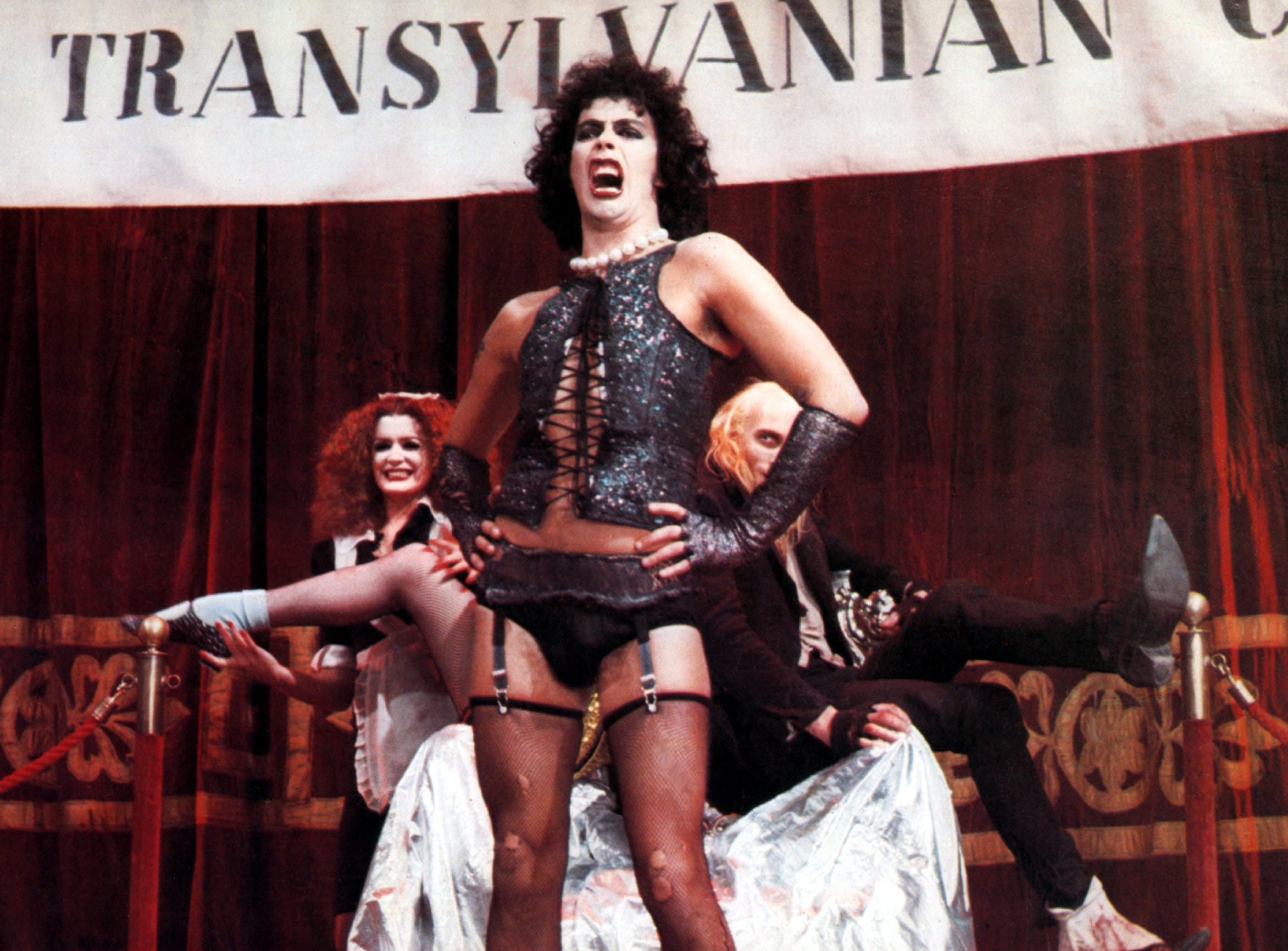
Tim Curry: A life of contradictions
In his new memoir ‘Vagabond’, one of the most distinctive actors of his generation reflects on a protean life and career.
Tim Curry is a shapeshifter. I have a childhood memory of the moment I learned that the demon in Legend (1985), the villain in Annie (1982), the butler in Clue (1985) and the cross-dressing alien scientist in The Rocky Horror Picture Show (1975) were all played by the same man. It was quite the revelation.
Curry’s protean talents have meant that as a personality he has forever remained mysterious. He rarely gives interviews – only grudgingly whenever there is a movie to promote – and fans have therefore tended to project onto this reclusive figure the persona that best fits their expectations or desires. When more insistent fans have formed an emotional bond with the Tim Curry of their imaginations, he has on occasion been forced to put them right. ‘I’m just a person,’ he says, ‘and I’m not your person’.
Fans will therefore be delighted at the publication of Curry’s memoir, Vagabond, which offers fascinating snapshots from his life. The approach is episodic, with chapters devoted to particular projects in his career. As such, Curry offers us morsels in lieu of a meal. Those who are hoping for salacious anecdotes about his love life will be disappointed, because – as he rightly points out – ‘specifics about my affairs of the heart or the bedroom are – respectfully – none of your fucking business’. Instead, we have a wonderfully compelling account of Curry’s origins and how his philosophy of life has informed his craft.


His vagabond status has been well earned. As the child of a military father, he was forever on the move, and it is easy to see how these early experiences shaped his capacity to embody such a wide breadth of humanity. His first accolade came early when he was awarded the prize for the ‘Most Beautiful Baby in Hong Kong’. His family relocated roughly every eighteen months for the first eleven years of his life, which is why he tells us that ‘mutability felt like a part of my DNA’. It was the ideal apprenticeship for his future vocation.
Writing in 1817, William Hazlitt called actors the ‘motley representatives of human nature’ who ‘show us all that we are, all that we wish to be, and all that we dread to be’. For his part, Curry sees the actor as the vagabond of his book’s title. ‘How can you trust somebody, or truly know somebody, who appears as a king one day and a jester the next? What does it mean when neither role is the true identity of the person, and when that very person might be gone the next day?’ In this, he could be paraphrasing Hazlitt’s description of actors as ‘today kings, tomorrow beggars’, and how ‘it is only when they are themselves, that they are nothing’.
One of the most rewarding aspects of Vagabond is this tension between the revelatory obligations of the autobiography and Curry’s desire to keep his audience at a distance. In other hands, this might have been a flaw; here, it adds to our understanding of the author’s worldview. His key philosophy in life struck him during a gap year of travelling across Europe and northwest Africa with his schoolfriend Richard Cork (later the art critic for The Times). Drunk on brandy one night in Marrakesh, the two friends made a pact: ‘henceforth, we would commit ourselves to exploring all our contradictions’.
This determination to embrace inner inconsistencies, not to ‘tamp them down’ but to ‘see them through to their conclusion’, has turned out to be Curry’s guiding tenet throughout his life and career. As he explains:
‘For me, exploring my contradictions has meant learning to be comfortable playing a range of parts – personally and professionally – and trying to embrace them all, even if they seem discordant or incompatible. Professionally, the lure of pursuing contradictions has drawn me toward complex characters or compelled me to make them more complex and nuanced: so, for example, a scoundrel who is also charming, or somebody rather abhorrent whom I can also play out as being quite irresistible. Those are the roles that have enticed me the most.’
The actor’s craft, for Curry at least, is an extension of this broader tendency towards introspective analysis. Even his embodiment of as outlandish a figure as Dr Frank-N-Furter in The Rocky Horror Show, on both stage and screen, has been an integral part of this vagabond’s personal journey. This anarchic rock ‘n’ roll homage to science fiction and horror B-movies enjoyed an immediate success when it opened on 19 June 1973 at the small venue upstairs at the Royal Court, on a night that was suitably stormy and lightning-streaked. Frank-N-Furter was Curry’s breakthrough role and, in spite of the movie’s initial failure at the box office, its subsequent cult status has ensured his legacy.
When I interviewed the show’s creator Richard O’Brien in 2013, he described Curry’s portrayal of Frank-N-Furter as ‘definitive’. Indeed, it is difficult to imagine how his performance in the movie version, with its delirious energy and lip-smacking abandon, could possibly be bettered. This presents a daunting challenge to the men who have filled those platform shoes over the half-century since the show premiered. As O’Brien told me: ‘We had one actor twenty or thirty years ago who said to me: “I hope you know, Richard, I’m stealing everything off Tim Curry”. And I thought that was an honest way to approach it.’


Vagabond contains perhaps the very best advice on how to approach the role. ‘None of the characters in the show are in drag’, Curry writes, ‘not even Frank, and their outfits shouldn’t be viewed with such a constrictive lens. We’re all wearing what people normally wear in Transylvania. Get the fuck over it. Don’t perform like you’re dressed in something inappropriate or transgressive; you’re wearing the national attire’. Most importantly, Frank doesn’t ‘camp around’ or pretend to be a woman. ‘He is a very strong, aggressive man… In other words, if you’re going to attempt to truly enter the character, wear your high heels like a man’.
For Curry to play such an extreme part as his feature film debut carried risks of future typecasting, yet the body of Curry’s work proves that he successfully manoeuvred his way through that minefield. He played Mozart in the Broadway production of Peter Shaffer’s Amadeus and was nominated for a Tony award. Other Tony nominations were to follow for his performances as Bill Snibson in Me and My Girl (1987-88) and as King Arthur in Spamalot (2004-2007). It is quite the leap from such theatrical turns to his famous on-screen villains – Pennywise the Clown in the miniseries It (1990) and Cardinal Richelieu in The Three Musketeers (1993) – but Curry makes it seem effortless.
Even in these most diabolical of guises, Curry insists that he has been able to draw on his life experience. Of Pennywise and Richelieu, he acknowledges that his ‘terrifying childhood memories’ of his mother – who possibly suffered from an undiagnosed form of bipolar disorder – informed his approach. And might it even be the case that he was thinking of his mother during his brutal axe murder of Meat Loaf’s Eddie in The Rocky Horror Picture Show? ‘Well, between us, yes,’ he confesses. ‘Yes, perhaps I was.’
Given the sheer range of his characters, one can appreciate why Curry has expressed such frustration when the inevitable question of typecasting recurs. It seems to originate in an expectation that he should be typecast, rather than an accurate observation of the truth. In real life, he is likewise impossible to pin down, so much so that at an early screening of The Rocky Horror Picture Show, a cinema manager tried to have him ejected from the premises for impersonating Tim Curry.
In his essay on acting, Hazlitt offers a pertinent quotation from Shakespeare’s All’s Well That Ends Well. ‘The web of our life is of a mingled yarn, good and ill together: our virtues would be proud if our faults whipped them not: and our vices would despair if they were not cherished by our virtues.’ This could serve as a fitting maxim for any actor, for whom even the most traumatic experiences can provide much-needed fuel for the vocation. Curry’s memoir in particular is a reminder that the actor’s various disguises are best assembled from the mingled yarn of his own life.
You can buy Tim Curry’s memoir Vagabond here.


As soon as I saw you had written a large article about the amazing Tim Curry, I thought he had passed away. Don't do that to us Andrew 😍
I love this book review and I will be very interested to read his biography. I don't think people understand how difficult is to create different personalities for the different roles and the talent needed to do just that. Many of our contemporary actors can play only themselves which is why so many films are flat and boring.
I saw one good Rocky Horror Show theatre performance back in Dublin but haven't been to others since. The posters did not give me the impression that they would be good. I saw an advertised production that even casted a woman for the role which is to tell you that they have completely missed the point.
P.S Did you manage to write this without doing the Time Wrap dance?