

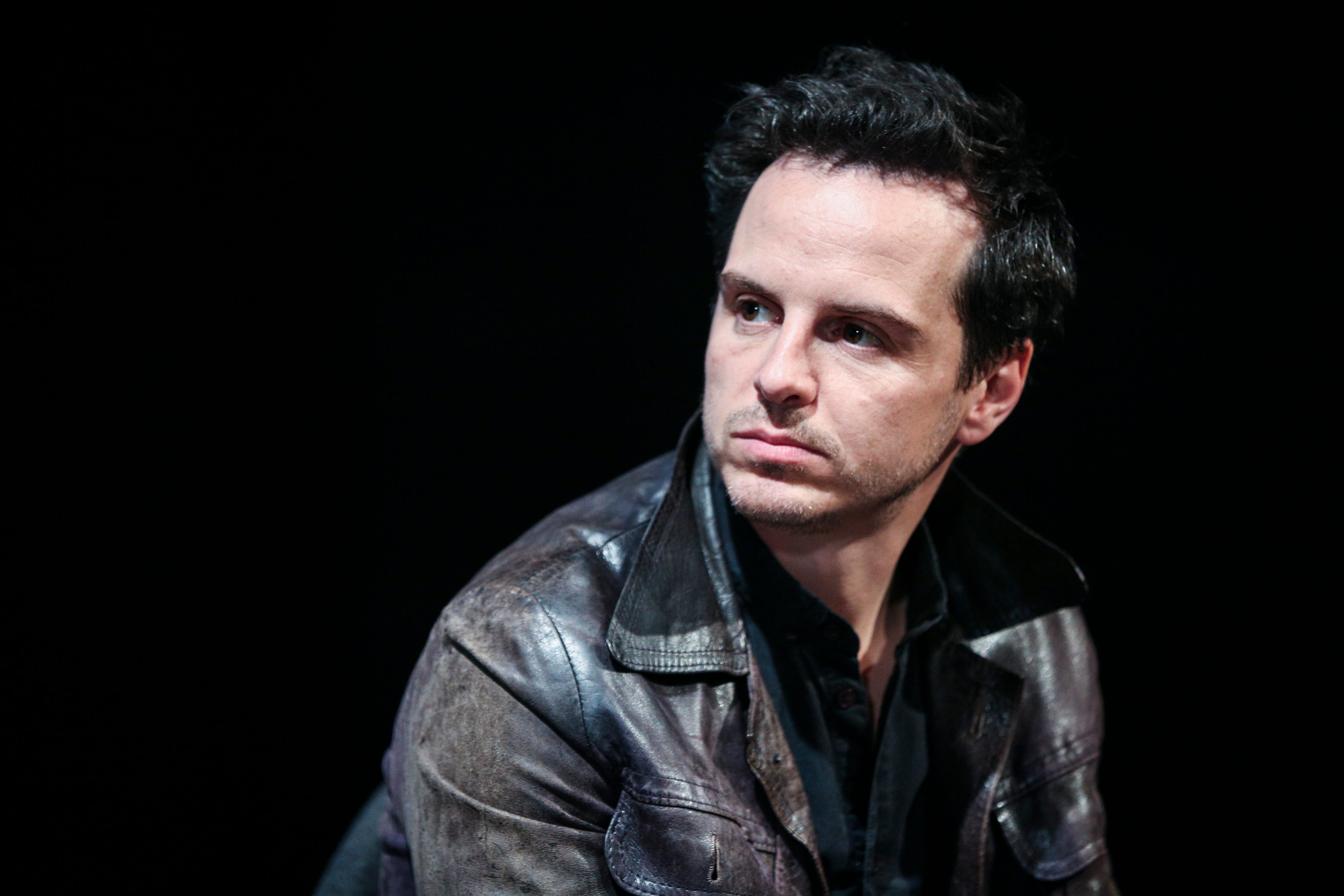
It is always reassuring to see Shakespeare trending. It suggests that the wheezing decline of Western civilisation still has some way to go. This week, this little reprieve was courtesy of the actor Andrew Scott, whose recital of Hamlet’s ‘To be or not to be’ soliloquy was circulating on X to great acclaim. Spencer A. Klavan called it ‘the best delivery of this soliloquy I’ve ever seen’, and there were many cries of assent in the comments.
It’s a fine performance, particularly when one considers what is at stake for an actor. This is the most famous monologue ever written for the most famous character in drama. In any production of Hamlet, the audience will be anticipating this moment, wondering how our lead will approach it, or whether he might surprise us with something new. Everyone knows the speech, so everyone has an opinion.
On a school trip to London in 1995, I was privileged to see Ralph Fiennes play the role, and the most memorable aspect of the production was that he rattled through the dreaded soliloquy so that it was finished before we knew it. It was a bold interpretative choice, one no doubt intended to capture the way in which Hamlet’s thoughts are outrunning his ability to marshal them – a kind of frenetic stream of consciousness – but to my green ears it sounded as though Fiennes was desperate to get it over and done with.
Scott’s approach is quite the opposite. Klavan argues that he ‘delivers this speech too slowly’ and that ‘some viewers will hate the way he breaks up the verse’. Judge for yourselves:
Scott is not the first to take this approach, of course, and Shakespeare invites it. His early plays – such as The Comedy of Errors and the three parts of Henry VI – tended towards a more rigid verse structure with end-stopped lines. Later, he developed an extraordinary fluidity with his use of enjambment (the sentence running across the line) and an increasingly flexible placement of caesuras (pauses that break the line; caesura means ‘cut’). This looser approach to iambic pentameter means that the poetry of the later plays can accommodate much greater psychological complexity.
This matters particularly in the great soliloquies, because it is here that Shakespeare’s innovation expands the dramatic medium beyond anything his predecessors had achieved. No longer were soliloquies simply vehicles for characters to provide exposition, but in them we hear unmistakably human voices wrestling with their own souls. Sometimes, as with Macbeth and Iago, the soliloquies expose aspects of the self that even the speaker barely comprehends. Hamlet, as the insatiable thinker, is never satisfied with the process of his own thoughts, and in his soliloquies we sense a man trying to persuade or reorientate himself, navigating that gulf between his desires and his instincts.
Take, for instance, that moment in the ‘To be or not to be’ speech in which a new thought intrudes and redirects the argument he is having with himself.
To die: to sleep –
To sleep: perchance to dream. Ay, there’s the rub,
For in that sleep of death what dreams may come
When we have shuffled off this mortal coil
Must give us pause.
This sense of self-interruption is best captured by the man who, in my view, achieved the best on-screen Hamlet.
Christopher Plummer played the role in the 1964 BBC television adaptation Hamlet at Elsinore (so called because it was filmed at Kronborg Castle in Helsingør, Denmark, the castle traditionally identified with Shakespeare’s Elsinore). The exceptional cast includes Michael Caine as Horatio, Robert Shaw as Claudius, June Tobin as Gertrude, and Alec Clunes handling the tricky role of Polonius better than I’ve ever seen, making him simultaneously irritating and endearing.
I cannot recommend this adaptation highly enough (you can watch it here). Plummer captures that turbulence of mind of a young man thrown into a role for which he is so ill-suited: that of the revenger. He seems to embody the Hamlet that makes the most sense to me: a fledgling philosopher who has been thrown into a traditional Senecan tragedy and is trying to fumble his way through it. Hamlet is, as William Hazlitt said, ‘a great moraliser; and what makes him worth attending to is, that he moralises on his own feelings and experience’. Not so Laertes, who would avenge his father’s death without hesitation, even if it costs him his soul.
The play’s major theme of revenge is why some critics have insisted that the opening of ‘To be or not to be’ is not primarily about suicide at all, but about whether Hamlet should take action against Claudius. On this reading, the question is initially not whether he should kill himself, but whether he should risk his own life in the act of vengeance.
To be, or not to be – that is the question.
Whether ’tis nobler in the mind to suffer
The slings and arrows of outrageous fortune
Or to take arms against a sea of troubles
And by opposing end them. To die: to sleep –
No more; and by a sleep to say we end
The heartache and the thousand natural shocks
That flesh is heir to? ’Tis a consummation
Devoutly to be wished.
I do not necessarily subscribe to this interpretation, but some productions have retained the possibility. Kenneth Branagh, in a performance that was far more bombastic than Plummer, delivered this soliloquy with an uncharacteristic restraint, and rather wonderfully sustained that ambiguity. His conceit was to have Claudius observing him through a two-way mirror, which meant that when he draws his knife on the words ‘a bare bodkin’, it is as though it is directed at the very man he wishes to kill. If Hamlet knows that he is being watched, the implications of the speech are even more varied.
Laurence Olivier’s 1948 film makes the suicidal implications unequivocal. He delivers the soliloquy on the battlements of Elsinore, suggesting that he might at any point teeter over, and even momentarily holding a knife towards himself. He takes advantage of the cinematic medium to convey some of the lines in voiceover, accentuating that quality of a mind at odds with itself. Olivier’s Hamlet allows the self-destructive impulse to pass, dropping his blade into the sea, which is of course in keeping with the character’s tendency to think himself out of action.
Mel Gibson’s rendition of the speech is likewise more directly in keeping with the notion of a young man gripped by suicidal thoughts. The director of that film, Franco Zeffirelli, even had Hamlet deliver the lines in a subterranean crypt surrounded by tombs and bones, thereby literalising the death that he contemplates. Gibson hesitates continually, seemingly searching for the next thought, a step closer to Scott’s more recent interpretation.
Getting Hamlet right is impossible. More than almost any character in literature, he seems to have escaped his creator and acquired a life of his own. He continues to evade us even while sharing his most private thoughts, and that paradox is one of the reasons no greater play has ever been written. Of the actors who have played him on screen, Christopher Plummer remains, for me, the most convincing. Which Hamlet is yours?
Andrew Scott's version: Nowan talks like thet. You mention Fiennes. I saw Ralph Fiennes in Troilus and Cressida decades ago and the whole cast was brilliant, including Simon Russel Beale as Thersites who looked as if he must stink of wee wee. He was disgusting! The fight scenes were terrifying. But I digress. Unless you are extraordinarily normal you will have rehearsed 'To be' yourself. I imagine myself doing something mundane like the ironing whilst wondering how I am going to deal with this issue. What I do do in this instance is to think of it as I think of most prickly problems; that is to form the idea aloud as the words tumble out. Bite sized chunks are right out. It is not meant to be a set of instructions on how to operate the bean to cup.
I watched each of these, having previously seen none of them, though I have seen other Productions. I didn't like the characterisation in the recent film. I will watch Plummer's production - I have always liked his performances on screen - and I had already planned to see the Branagh film, at long last. Thanks for your essay.