The moment that woke began to crumble
An excerpt from ‘The End of Woke’, out today in paperback.
Today sees the publication of my book The End of Woke in paperback. It’s a ‘book of the year’ in the New Statesman, the Spectator and Compact Magazine. You can read reviews here.
And to whet your appetite, here’s the book’s prologue, in which I argue that while woke is not yet dead, it has sustained too many wounds to persist in the form it once took. In The End of Woke, I explore the key question: what comes next?
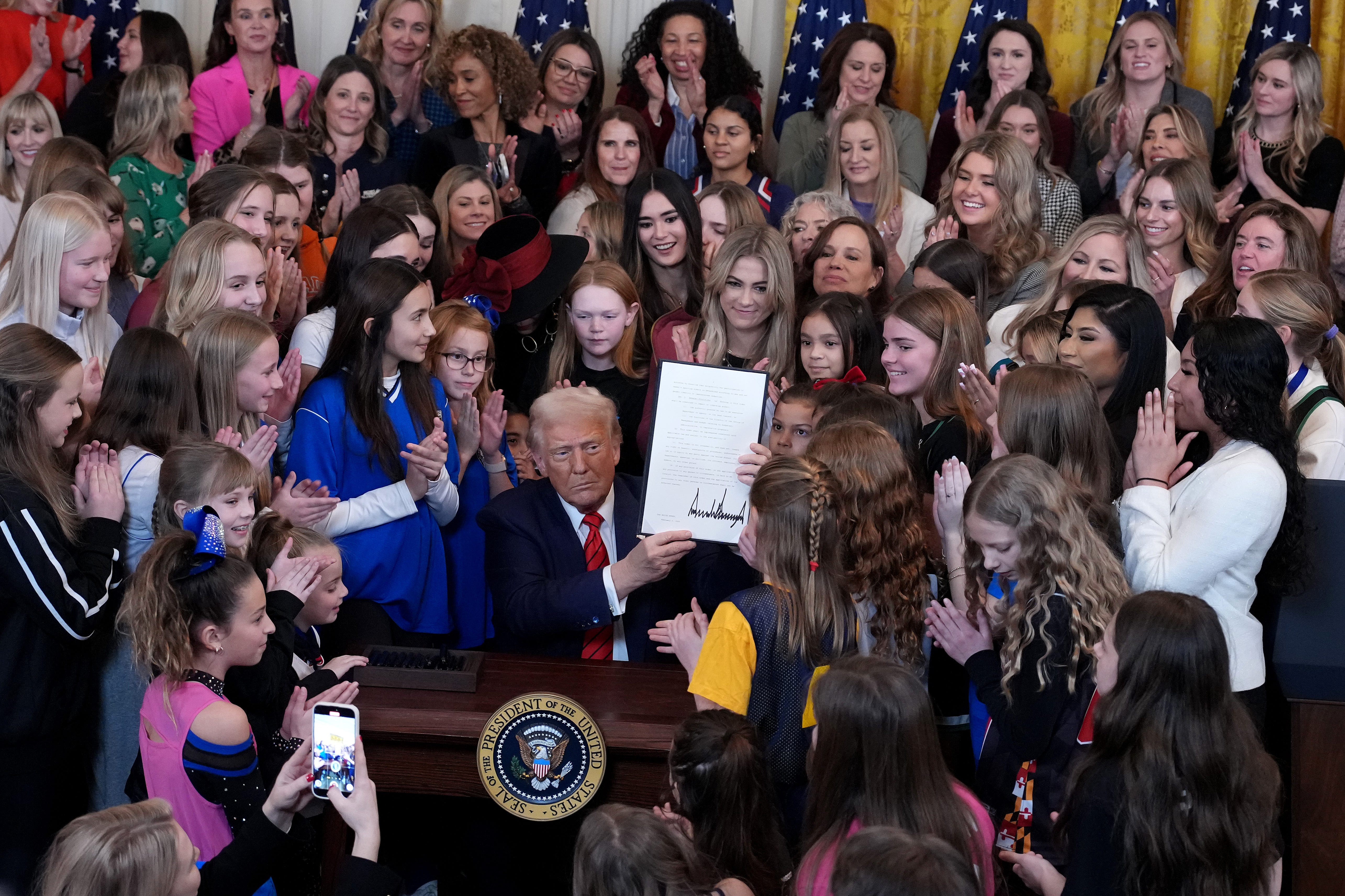
It was an extraordinary scene. Donald Trump, recently re-elected as president of the United States, found himself surrounded by women and girls in the East Room of the White House. The date was 5 February 2025, and Trump was signing an executive order entitled ‘Keeping Men Out of Women’s Sports’. As the president took to his desk and prepared his pen, he invited his all-female audience to draw closer. ‘Secret service is worried about them?’ he joked. ‘If we have to worry about them we have big problems.’ There was laughter, applause, a hubbub of palpable relief that an egregious social injustice was on the cusp of being corrected. Photographers captured the moment in a flurry of snapping shutters. Would this be the image that marked the beginning of our post-woke era, the first phase of sobering up for a once drunken world?
The significance of this event could not be dismissed as a mere publicity stunt. Here was one of the most controversial Republican presidents in history, a man who had been accused repeatedly of misogyny, nevertheless enacting the most pro-feminist directive since Richard Nixon signed Title IX of the Education Amendments in June 1972, a measure that prohibited sex-based discrimination in federally funded educational institutions. The culture war of our times has often been misinterpreted as a conflict between left and right but, as I shall argue, these designations are hangovers from the French Revolution, ill-suited to today’s complex ideological skirmishes. The sudden rise in the early 2010s of Critical Social Justice – that sprawling, complex and disparate movement known colloquially as ‘woke’ – has meant that the terms ‘left’ and ‘right’ have lost much of their utility. Definitions of ‘woke’ are as varied as can be imagined, but it is best understood as a cultural revolution that seeks equity according to group identity by authoritarian means. Yet for all its institutional clout, this ideology has never enjoyed popular support. Estimates by More in Common, a nonprofit organisation committed to the promotion of social cohesion, suggest that at its height the woke movement was endorsed by approximately eight per cent of the population of both America and the United Kingdom. As such, its power could only ever be sustained through misdirection and imposition.
This is why Trump’s executive order received such an overwhelmingly positive reception from across the political spectrum. A poll by NPR and Ispos in 2022 showed that 63 per cent of Americans did not approve of men who identify as female competing in women’s sports. By January 2025, a poll by the New York Times and Ipsos revealed that this figure has risen to 79 per cent. Even among Democrat voters, a significant majority (67 per cent) supported the principle of keeping men out of the female category. For such a divisive figure, Trump had somehow found a unifying cause. The author J.K. Rowling echoed the feeling of many Democrat voters when she posted on social media a photograph of Trump signing the executive order and wrote: ‘Congratulations to every single person on the left who’s been campaigning to destroy women’s and girls’ rights. Without you, there’d be no images like this’. It was not so much that Trump had suddenly rebranded the Republican Party as liberal, but that Democratic leaders had embraced the politics of illiberalism. Evangelists of the woke movement had seized disproportionate power in a relatively short time precisely because their aims had been so widely misapprehended. They had dissembled and played endless word games to coax unsuspecting progressives into backing regressive causes. So while it felt almost oneiric to witness a Republican president upholding the ideals once championed by the left, this was simply a reminder that our liberal consensus still prevailed in spite of the best efforts of culture warriors. We have far more in common than the extreme identitarians on both the left and the right would have us believe. To our shame, we have allowed the most brattish and irrational voices to dictate the terms of debate.
The culture war, in other words, is the politics of infantilism writ large. This has been borne out by my own experiences. When I announced in May 2021 that I was working on a book about the origins of the social justice movement and how it fosters aggressive and childish behaviour, some activists immediately suggested that they would acquire copies only to burn them. One said that he intended to kick it under the bookshop shelf ‘so that it could rot in darkness’. A left-wing website called Byline Times even claimed that I was waging ‘a perpetual battle against social justice – fighting against a contrived present world of aggressive “woke snowflakes” in order to return to an imagined past’. This was news to me given that my book was a defence of liberal values, a critique of intolerance, and it explicitly reproached those who resort to the ‘snowflake’ slur. I particularly enjoyed the suggestion that I had conjured enemies into existence in order to fight them. It takes some chutzpah to make such a claim of a book you haven’t actually read.
It would seem that the title alone – The New Puritans: How the Religion of Social Justice Captured the Western World – was enough to stir the ire of these culture warriors. In a sense, this is unsurprising. One of the key aspects of the woke movement is that its adherents treat all challenges as a form of heresy that must be quashed. For all the relish with which they smear their detractors as ‘bigots’, they forget that the principal definition of the word – ‘a person who is utterly intolerant of any differing creed, belief or opinion’ – applies most accurately to themselves.
That book was intended to be my final word on the subject, and yet since its publication in 2022 the culture war has developed in surprising and significant ways. In The New Puritans I traced the origins of Critical Social Justice and explored its various metamorphoses and ultimate cultural ascendency. Now we find ourselves entering a new phase of the culture war, one in which the woke ideology is being tamed and will soon relinquish its chokehold on the Western world. The Black Lives Matter protests and riots of the summer of 2020 had propelled the movement into overdrive. The countersigns of virtue were now firmly established: taking the knee, demolishing ‘problematic’ statues and historical landmarks, waving the rainbow ‘Progress Pride’ flag, declaring pronouns, wearing masks even where there was scant risk of infection, hounding dissenters through a retributive system known as ‘cancel culture’. Big tech was cracking down on free speech, governments were ramping up legislation to punish citizens for thought crimes, universities were promoting dogma rather than the pursuit of knowledge, and all of this was ostensibly happening in the name of progress. Something had gone very wrong; authoritarianism was winning.
In repackaging their authoritarian instincts as ‘progressive’, the woke had destabilised an ongoing liberal project that had been making tremendous headway since the civil rights movements of the 1960s. They supported draconian speech codes and suppression of their political opponents. They modified school curricula so that children were taught new pseudo-religious creeds, including the belief that all white children are complicit in racial supremacy and that biological sex is a kind of fiction. Having secured bureaucratic, managerial and political dominance in both the public and private sector, they attempted to re-engineer society so that we might achieve equality of outcome rather than equality of opportunity. They preached their belief that society operates according to invisible power structures that perpetuate inequality, and that these can only be redressed through a fanatical emphasis on group identity and the recognition that – in the words of activist Ibram X. Kendi, author of How to Be an Antiracist (2019) – ‘The only remedy to past discrimination is present discrimination’. As I have argued many times, the closest synonym for what we now call ‘woke’ is ‘anti-liberal’.
Culture wars never die, but they do evolve. The power of the woke movement is now perishing as quickly as it was birthed, and we find ourselves treading unfamiliar terrain. Its hegemony in the arts, the media, law enforcement, education and the corporate world is still intact, but no longer seems unassailable. Trump’s slew of executive orders in January 2025 was not limited to the matter of sports. He signed orders to recognise that ‘women are biologically female, and men are biologically male’, to put an end to prisoners being accommodated according to ‘identity’ rather than sex, and to prevent federal agencies from supporting ‘the so-called “transition” of a child from one sex to another’. Although these orders go some way to reinstating protections for the rights of vulnerable people, the method was troubling for those of a liberal disposition. Executive orders were originally intended to be memoranda from the president to officials in the executive branch of government, but in recent years they have been used as a shortcut to implement policy changes at breakneck speed. Like the president’s right to pardon convicted criminals, this procedure has a certain monarchical quality to it, which accounts for Trump’s previous quip about being a ‘dictator’ on ‘day one’. That said, executive orders have been adopted with increasing frequency by Republican and Democratic presidents alike. Both parties have been happy to take advantage of a system that permits the president to sidestep Congress and act unilaterally.
Those of us who have opposed the power of the woke movement on liberal grounds will have mixed feelings about the prospect of its demise being partly actuated by illiberal means. We will be concerned about Trump’s misjudged choice of language, such as his high-handed statement that ‘He who saves his Country does not violate any Law’, a sentiment that would surely be echoed by any autocrat in history. At the same time, the pushback against Trump’s executive orders has been similarly troubling, with unelected judges in Democrat-run districts – what Press secretary Karoline Leavitt described as ‘judicial activists’ – quickly applying temporary blocks to specific executive orders that threatened to undermine the woke orthodoxy. This was predictable, since many of these directives were the antithesis of those signed by President Joe Biden. On his first day in office in January 2021, for instance, Biden had issued an executive order ‘Preventing and Combating Discrimination on the Basis of Gender Identity or Sexual Orientation’ which insisted that identity rather than sex should be the determining factor when it comes to sports, toilet facilities and other aspects of life traditionally divided into male and female. Similarly, Trump’s order aimed at ‘Ending Radical and Wasteful Government DEI Programs and Preferencing’ was a direct countermand of Biden’s order ‘Advancing Racial Equity and Support for Underserved Communities Through the Federal Government’. Although Biden had secured the nomination as leader of his party as the ‘non-woke’ candidate, his first few days in office made it clear that this was an agenda that he would vigorously pursue.
By contrast, Trump’s mandate was to dismantle the woke apparatus put into place by his predecessor, most notably its commitment to Diversity, Equity and Inclusion (DEI). Under Trump, meritocracy and colour-blindness were to be reinstated, and the new fashionable form of racial discrimination was to be jettisoned. The impact was felt almost instantaneously. Federal workers from the DEI industry were placed on administrative leave, websites and social media accounts were modified to reflect the new policies, and contracts related to DEI work were scotched. The shockwaves radiated beyond the machinery of the state and out into the corporate world. Even before Trump’s inauguration, Mark Zuckerberg, CEO of Meta, announced that he was terminating the company’s DEI programmes, with an internal memo explicitly recognising that ‘the legal and policy landscape surrounding diversity, equity and inclusion efforts in the United States is changing’. Other companies – including giants such as McDonald’s, Walmart, Ford, Amazon and Google – quickly followed suit and scaled back their DEI commitments and goals. For all the incessant declarations of the ‘values’ of corporations and their capitalist shareholders, few were surprised to see such ethical considerations subordinated to the acquisition of money. Fidelity to DEI was sustainable right up until the point when infidelity became more profitable.
These relentless salvos against the woke movement culminated in the establishment of Trump’s ‘Department of Government Efficiency’ (DOGE) – spearheaded by entrepreneur Elon Musk – which stripped back the $124 billion of annual federal spending on DEI initiatives. This was Musk’s glasnost to Trump’s perestroika, a shift from bureaucracy to transparency that shattered the carapace of the fallen regime. As a result, the public were suddenly barraged with news stories about how taxpayers’ money had been gratuitously wasted on woke projects. Most notably, it was revealed that the United States Agency for International Development (USAID) had been funding causes overseas that seemed more proselytising than humanitarian. While even the most jingoistic of patriots might appreciate the moral justification for USAID’s contributions to landmine-clearance, disease prevention, and aid for refugees displaced in war – all of which were curbed under the new administration’s policies – there would be meagre support for its ideological boondoggling. For instance, $2 million had been earmarked to subsidise pottery classes and promotion in Morocco. A further $2 million had been awarded to Asociación Lambda, a Guatemalan LGBTQ+ rights organisation, to ‘strengthen trans-led organizations to deliver gender-affirming health care, advocate for improve quality and access to services, and provide economic empowerment opportunities’. A grant of $13 million went to the nonprofit organisation Sesame Workshop to fund a version of Sesame Street in Iraq (Ahlan Simsim Iraq) which would focus on the promotion of ‘inclusion, mutual respect, and understanding across ethnic, religious, and sectarian groups’. The nature of much of the expenditure meant that the relevant aspects of Trump’s speech to the joint session of Congress in March 2025 had the quality of a stand-up comedy routine.
‘Just listen to some of the appalling waste we have already identified: $22 billion from HHS to provide free housing and cars for illegal aliens, $45 million for diversity, equity and inclusion scholarships in Burma, $40 million to improve the social and economic inclusion of sedentary migrants. Nobody knows what that is. $8 million to promote LGBTQ+ in the African nation of Lesotho, which nobody has ever heard of, $60 million for indigenous peoples and Afro-Colombian empowerment in Central America. $60 million. $8 million for making mice transgender.’
Those in charge of USAID had jeopardised its credibility and humanitarian work through this pursuit of what journalist Andrew Sullivan described as the ‘pet ideological projects’ of ‘our enlightened elites’. It is a reminder of one of the key lessons of this culture war: when any given organisation is ideologically captured, it ceases to function effectively and becomes primarily a mechanism for the propagation of the creed.
The victory of Donald Trump over Kamala Harris in the presidential election of November 2024 is already being celebrated as the moment that woke died, the final reckoning of this short-lived paradigm shift, but it was a symptom rather than a cause. Certainly there is no doubt that in throwing its support behind Trump, the electorate was rejecting an ideology that had been imposed from the top down against their wishes. Woke was never a belief-system sincerely held by any significant numbers; it was a set of rules and mantras adopted out of fear by a subdued population. By steamrolling over this ideology in his first few weeks in office, Trump was fulfilling a promise that had been articulated throughout his campaign. This was incontrovertible proof that culture war issues can win and lose elections; even many of those who despised Trump voted for him as a means to resist the careening juggernaut of wokeness. In its post-election analysis, the New York Times singled out a Republican advertisement which drew attention to Harris’s statement that all prison inmates identifying as transgender ought to have access to surgery. The tagline was: ‘Kamala is for they/them. President Trump is for you’. Although the writers of the article considered this a ‘seemingly obscure topic’, they were forced to admit its success. Even Trump’s aides had been astonished at the campaign’s popularity. According to the political action committee Future Forward, a group established to support the Democratic party, this advertisement triggered a 2.7-point shift in favour of Trump among those who saw it. Inevitably, the New York Times misclassified the message as ‘anti-trans’, a ploy guaranteed to exacerbate the very resentment that made the slogan so effective in the first place. They had forgotten, or never knew, that trans activism in its current form is essentially authoritarian, because it seeks to foist a belief-system onto a population that does not share it.
The death rattles of the woke ideology have become so audible that they can no longer be gainsaid. Leftists politicians such as Democratic representative Alexandria Ocasio-Cortez and the US secretary of transportation Pete Buttigieg have quietly removed the pronouns from their social media profiles. Multiple sporting bodies have barred men who identity as women from competing in female categories. Gay rights groups are rejecting the forced teaming with divisive LGBTQIA+ campaigns. Puberty blockers for the treatment of gender dysphoria in children have been banned indefinitely in the United Kingdom. This followed on from one of the most transformational developments in the culture wars: the Independent Review of Gender Identity Services for Children and Young People – typically known as the Cass Review – commissioned by the National Health Service (NHS) of the United Kingdom in 2020 and carried out by leading paediatrician Dame Hilary Cass, which was published in April 2024 (see Chapter 7). At last, the public had confirmation that there is a paucity of evidence for the efficacy of puberty blockers, and the reverberations are still being felt. Major medical bodies worldwide had been treating young patients on the basis of a superstitious and pseudoscientific belief in ‘gender identity’ and unquestioningly practising the ‘gender-affirming’ model of healthcare (by which therapeutic treatment for gender dysphoria is rejected in favour of an automatic reinforcement that the patient has been ‘born in the wrong body’ and requires medical intervention). The Cass Review has changed everything. Its goal was to elucidate the truth; it ended up being a wrecking ball to the delicate piñata of the new fundamentalism.
Statistical analysis of polling data by the Economist found that support for woke causes began to grow in 2015, peaked in 2021, and have been steadily declining ever since. Black Lives Matter is now a largely discredited movement. Although not centralised, many of its key figureheads have been exposed as fraudulent. Having raised over $90 million in the wake of the death of George Floyd, by May 2023 the Black Lives Matter Global Network Foundation was facing bankruptcy. One of its co-founders, Patrisse Cullors, was found to have spent $3.2 million on luxury homes, although she claimed these were private funds. Its tax filing of May 2022 revealed expenditure on luxury properties to the tune of $12 million, with significant sums paid to Cullors’s relatives for security services. After the massacre of civilians in southern Israel by Hamas on 7 October 2023, a Black Lives Matter affiliated organisation in Chicago posted ‘I stand with Palestine’ on social media along with an image of one of the terrorists who had committed the atrocity, identifiable due to the paraglider used in the attack. Anti-Israel protests across the Western world broke out, but the explicitly antisemitic tenor of some of the participants changed the nature of the debate. Palestine had become a compulsory talking point for the woke, but it appeared that racism was baked into the ideology.
A seemingly frivolous but perhaps equally revealing moment occurred when the car company Jaguar released a new advertisement campaign in November 2024. A short commercial showcased a number of flamboyant epicene models posing against a minimalist but colourful backdrop, with syntactically inelegant slogans appearing periodically on the screen, such as ‘live vivid’ and ‘delete ordinary’. No vehicles were featured, and it looked very much as though Jaguar was more interested in promoting the doctrine of DEI rather than selling cars. Inevitably, the company’s sales soon plummeted, but the significance was in the broader reaction. Like many woke initiatives, the concept was rooted in conformism masquerading as radicalism. A few diehard activists praised the company’s new direction, but the effort seemed forced; whimpers rather than cheers, the faintest borborygmi of an ageing beast. The overriding impression was one of fatigue. An advertisement that would have been standard fare in 2020 suddenly felt very dated.
So is woke truly at an end? Gentle reader, if you will indulge me, I would ask that you take a moment to envisage your author in sackcloth and sandals, staff in hand, standing upon a hillock to declare my prophesy: ‘the end of woke is nigh’. It is both melodramatic and almost certainly accurate. The influence of woke still lingers, of course, and the ideology will doubtless find a way to mutate and resurrect in some other guise. In addition, we are already seeing the rise of an ‘anti-woke’ contingent that may fill the vacuum. In seeking to re-establish the importance of freedom and liberal values, some leading figures of this predominately right-leaning counter-movement have now reached the conclusion that the only effective response to ‘wokery’ is a different kind of authoritarianism. As the saying has it, they hope to fight fire with fire, and as such have earned themselves the much-contested label of ‘the woke right’. Those of us who have taken a stance against the excesses of the illiberal left would be advised to be vigilant about the possibility of a backlash that will only guarantee the continuation of this culture war. We should be striving to return to a time when absurdities were treated with the indifference they deserve, and the shrill demands of a handful of ideologues were drowned out by the steady chorus of reason.
This present volume is intended to reflect these developments, and to show that the authoritarian impulse at the heart of wokeness is replicated wherever human beings succumb to ideological thinking. The culture war has been needlessly prolonged due to this common insistence that it can be reduced to a matter of party politics. As I shall propose, far from blaming the left for this ongoing societal upheaval, we must acknowledge that culture warriors exist across the political spectrum. This has never been a matter of left or right, but rather what John Stuart Mill in 1859 called the ‘struggle between Liberty and Authority’. My concern is how we reached this period of competing narratives and regressive tribal politics, where we might go next, and how we should learn from the recent past to guide us through the imminent future. It is an argument for the cooling of temperature, the detribalisation of politics, the acknowledgement that no group has all the answers. It is a reminder that we have as much to learn from our critics as they might learn from us, that there is a kernel of truth even in the most grievous falsehood, and that our agency is diminished if we insist on reciting someone else’s script.
Some of the arguments in this book might resonate, others will doubtless infuriate. The urge to dismiss perspectives that do not precisely align with our own is instinctive, but ultimately self-destructive. How you respond to this book will be a test of its thesis. This, I suppose, is a sly way of absolving myself of all responsibility if you do not enjoy it. A cynic might say that I have forged a career from the very ideology I so despise, and yet I would like nothing more than my commentary from the last five years to become obsolete. I am writing these words now in the sincere hope that we will soon reach the point where nobody will want to read them. If all goes to plan, the book you are holding in your hands will be little more than a historical curiosity. It might make a decent doorstop.
You can buy the paperback of The End of Woke here.


