A Proposal for a Renewed Scientific Investigation of the Palazzo Vecchio Wall

Executive Summary

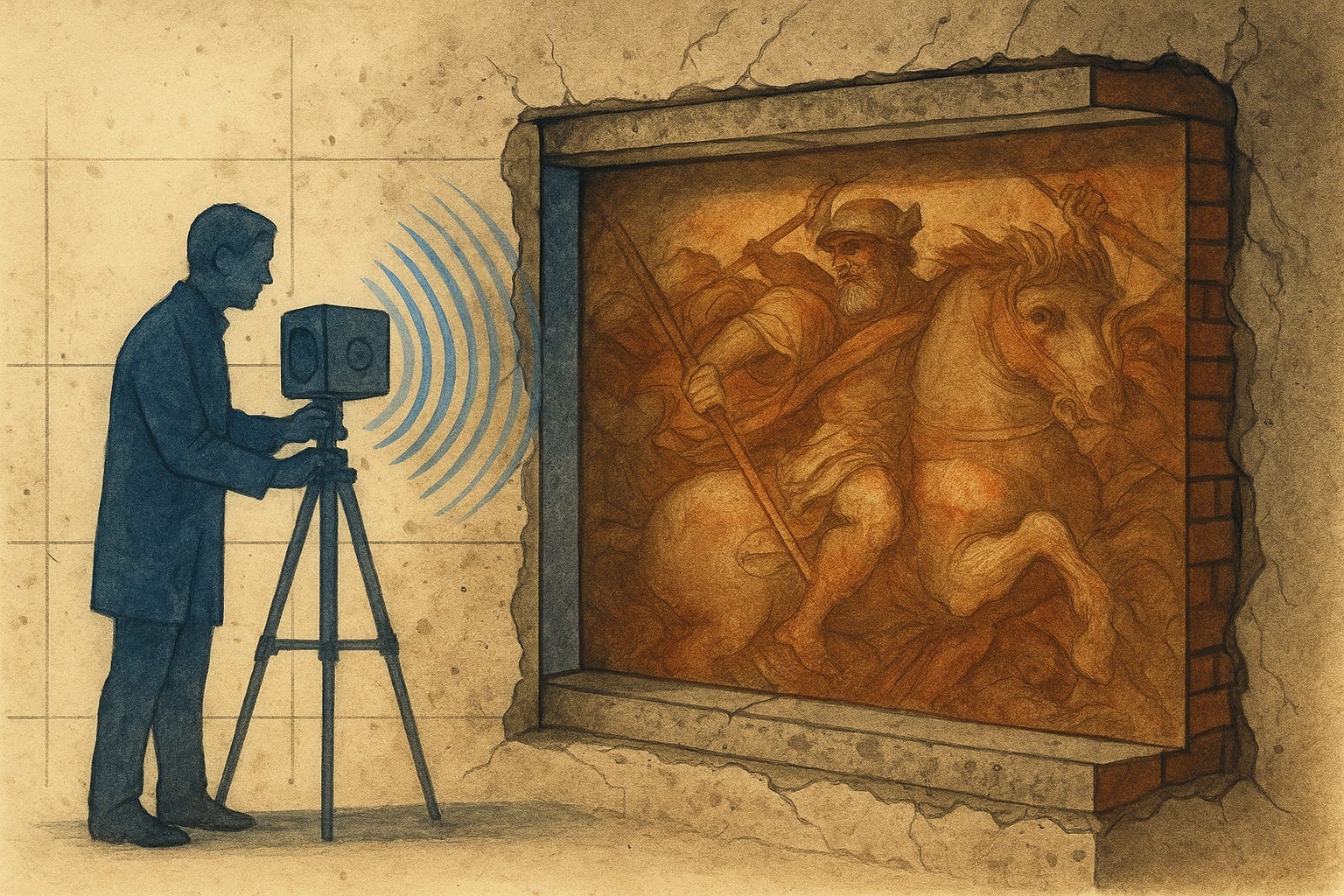
This document outlines a technically rigorous, fully non-destructive plan for a renewed scientific investigation of the east wall of the Salone dei Cinquecento in Florence’s Palazzo Vecchio—the site where Leonardo da Vinci began work on the Battle of Anghiari in 1505. Subsequent renovations by Giorgio Vasari may have concealed the surviving painting behind a secondary wall. Advances in imaging, materials science, and AI-driven reconstruction since the suspension of previous investigations in 2012 now make it possible to determine, with far greater certainty and with no physical intervention of any kind, whether any part of Leonardo’s original mural survives.

A carefully designed, phased investigation can answer this question responsibly and conclusively while fully respecting conservation ethics, cultural sensitivities, and the legal framework governing Italian heritage sites.


1. Background and Rationale

Leonardo da Vinci’s Battle of Anghiari was one of the most ambitious artistic undertakings of the Florentine Republic. Contemporary eyewitnesses—including Bartolomeo Cerretani, Paolo Giovio, and Giorgio Vasari—attest that Leonardo applied paint to the wall. No authoritative Renaissance source claims otherwise.

In the mid-sixteenth century, Vasari radically remodelled the hall, covering the walls with his own frescoes. Scholarly debate continues as to whether he built a new facing wall or sealed Leonardo’s damaged work behind a layer of plaster. Previous scientific efforts (2000–2012), though pioneering at the time, were constrained by the limitations of early imaging technologies and halted before definitive conclusions could be reached.

In the intervening decade, significant advances in non-invasive imaging now permit far more detailed analysis of complex stratigraphy within thick masonry structures. Deploying these tools in a controlled, multi-phase investigation would materially improve our understanding of the wall’s internal architecture and the fate of Leonardo’s painting—entirely without touching or disturbing the Vasari fresco.

The goal is not to “recover a lost masterpiece,” but to answer a longstanding historical question using the safest and most advanced methods available.


2. Governance, Permissions, and Risk Management

Before scientific work begins, the project requires:

Institutional Approval

  • Comune di Firenze

  • Soprintendenza Archeologia, Belle Arti e Paesaggio

  • Palazzo Vecchio management and conservators

Oversight Mechanisms

  • A joint advisory board of Italian conservators, art historians, structural engineers, and imaging specialists

  • Independent conservation risk assessment

  • Full insurance coverage for all activities, notwithstanding their non-invasive nature

Timeline & Cost

A realistic preparatory phase requires 6–12 months, with professional costs of €150,000–€300,000 for permissions, legal compliance, conservation audits, and insurance.

This administrative foundation is essential for any responsible scientific inquiry.


3. Technical Plan: Phased, Non-Destructive Investigation

Phase 1 – Surface and Structural Mapping

Objective: establish a baseline 3D and dielectric model of the wall.

Methods:

  • High-resolution 3D laser scanning and photogrammetry

  • Ultra-Wideband (UWB) radar tomography

  • Ultrasonic/acoustic tomography for layer-thickness mapping

Outputs:

  • A volumetric model of the Vasari fresco, underlying plaster layers, any cavity, and the rear wall

Estimated cost: €250,000–€550,000

Phase 2 – Terahertz Imaging

Objective: resolve fine stratigraphy and detect interfaces close to the Vasari surface.

Method:

  • Terahertz Time-Domain Imaging (TDI) to identify dielectric boundaries, thin air gaps, and candidate plaster faces

Rationale:

Terahertz imaging is especially sensitive to shallow subsurface structures and painted layers located just behind a secondary wall.

Estimated cost: €200,000–€500,000

Phase 3 – Advanced Material-Sensing (Optional)

Objective: identify the presence of metal-bearing pigments on a hidden surface without physical access.

Options:

  • Portable neutron backscatter systems

  • Nuclear Quadrupole Resonance (NQR) for pigment-specific signals

Note:

These methods carry additional regulatory and political constraints and would be deployed only if earlier phases indicate anomalies consistent with a painted layer.

Estimated cost: €700,000–€2,100,000

Phase 4 – Laser Vibrometry and Acoustic Modelling

Objective: characterise the physical texture of the concealed rear surface—smooth plaster, rough stone, or prepared intonaco.

Method:

  • Scanning laser Doppler vibrometry with low-amplitude acoustic excitation

Estimated cost: €100,000–€300,000

Phase 5 – Multimodal AI Reconstruction

Objective: integrate all datasets into a single coherent 3D interpretation.

Methods:

  • Fusion of radar, THz, vibrometric, structural, and historical data

  • Machine-learning reconstruction of internal surfaces

  • Identification of pigment anomalies, compositional outlines, and plaster-type signatures

Estimated cost: €300,000–€800,000


4. Total Estimated Budget

Depending on the chosen scope:

  • Lean, high-impact programme (Phases 1–2 + limited modelling): €400,000–€800,000

  • Full, multi-modal scientific investigation (Phases 1–5): €1.7 million–€4.0 million

  • Ambitious “moonshot” version, incorporating neutron/NQR physics and extensive AI modelling: €4 million+

These figures are consistent with major conservation-science projects undertaken by leading museums worldwide.


5. Obstacles and Mitigation

Conservation Risk

Mitigation: the plan is entirely non-destructive; all methods operate at a distance and impose no physical contact with the fresco.

Scholarly Sensitivities

Mitigation: a neutral advisory board; transparent data-sharing; peer-reviewed publication.

Public and Political Optics

Mitigation: present the project as a responsible heritage inquiry using non-invasive technologies—not a recovery attempt.

Cost vs Certainty

Mitigation: begin with an affordable pilot (Phases 1–2) that yields a detailed structural model before committing to more advanced phases.


6. Recommendation: A Sensible, Politically Sellable Path Forward

Begin with a €400k–€800k pilot programme limited to:

  • 3D structural scanning

  • Radar tomography

  • Terahertz layer mapping

  • Vibrometry

These methods alone can, with 2025 technology, determine:

  • whether a cavity exists;

  • whether the rear face of that cavity bears a smooth intonaco;

  • whether that intonaco contains pigment-like dielectric signatures.

This approach provides a decisive improvement over past efforts while remaining completely risk-free.


Conclusion

A new investigation of the Palazzo Vecchio wall is scientifically justified, technologically feasible, and fully non-invasive. The tools now available did not exist in 2012. With them, we can answer—decisively and without risk—the question of whether any part of Leonardo’s Battle of Anghiari survives behind Vasari’s fresco.

The time has come for Florence to make that determination using modern methods and complete transparency. This proposal provides a clear, responsible path to do so.